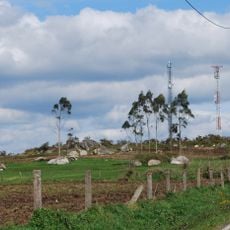
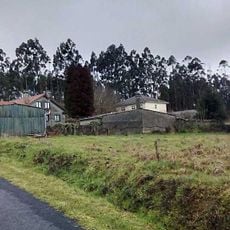
Monastery of Santa María de Mezonzo, Medieval monastery in Vilasantar, Spain.
The Monastery of Santa María de Mezonzo is a religious complex with medieval characteristics located in the village of Vilasantar in northern Spain. The buildings display Romanesque architectural elements such as characteristic apses and a main entrance facing west, typical features of churches from this period.
The monastery was founded as a double convent by Abbot Reterico, probably on a site dating back to the Kingdom of the Suebi. According to Antonio López Ferreiro it was donated to King Alfonso III in 870, but Eduardo de Hinojosa and Justo Pérez de Urbel date Reterico's donation charter to 17 September 930, under Alfonso IV. It was rebuilt in the 12th century in Galician Romanesque style, later joined the Cistercian reform and ended as a priory of San Martín Pinario.
The monastery was a double convent under Abbot Reterico, housing both monks and nuns. Its scriptorium held an important library, and Abbot Pedro de Mezonzo, later bishop of Iria-Santiago, is credited with the Salve Regina prayer. The monastery later joined the Cistercian reform promoted by Bernard of Clairvaux and became a priory of San Martín Pinario.
The church stands in the parish of Santa María de Mezonzo, in the municipality of Vilasantar, reached by local roads; a car is the practical way to get there. Look for the north portal with its double archivolts and the detached bell gable, probably built over an older monastic structure. The west facade is framed by buttresses around a triple-archivolt doorway.
The monastery was originally established as a double convent where both male and female religious communities coexisted under Abbot Reterico's leadership. This arrangement was unusual for its time and reflects a progressive approach to how different monastic groups could work together.
The community of curious travelers
AroundUs brings together thousands of curated places, local tips, and hidden gems, enriched daily by 94,788 contributors worldwide.