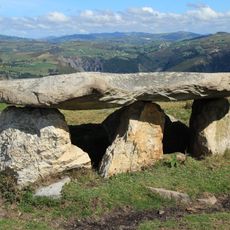
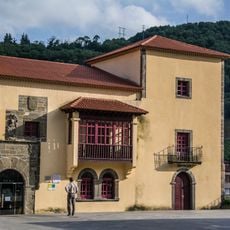
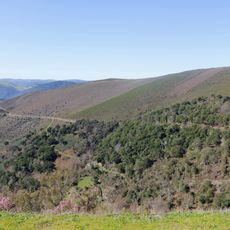
Castro de San Chuis, Archaeological site in Allande, Spain.
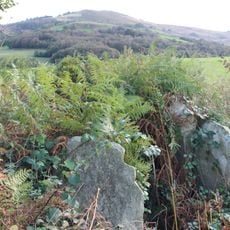
Castro de San Chuis is a fortified settlement on a hilltop at 783 m, with an approximately triangular plan enclosed by a modular wall around the entire perimeter. Ditches are limited to the most vulnerable flanks: a forward trench to the west and up to six ditches with counter-ditches to the southwest. Over twenty buildings have been excavated inside, mostly circular or oblong huts, with two rectangular Roman-period structures in the northeast upper quarter.
The settlement began in the 8th century BC and was later taken over and modified by Romans in the 1st century AD. This transition brought new building practices that altered the original layout.
The buildings on site reveal how different construction styles were used as the settlement changed hands between peoples. Visitors can observe the contrast between earlier round structures and later rectangular buildings that reflect different building traditions.
The site sits on a ridge and is reached via a forest track branching off from San Martín de Beduledo. The terrain is uneven with hillsides, so sturdy footwear helps when moving between the different sections.
The site was found in 1952 by José Lombardía Zardaín, a resident of the council, which led to its recognition by Francisco Jordá Cerdá of the Provincial Archaeological Service. Excavations began in August 1962 in the lower quarter, and campaigns resumed from 1979 to 1986 in the upper quarter, where fifteen buildings were recorded.
The community of curious travelers
AroundUs brings together thousands of curated places, local tips, and hidden gems, enriched daily by 94,482 contributors worldwide.