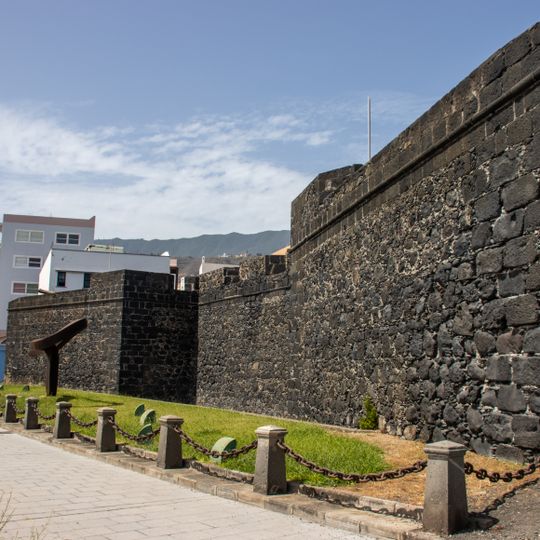
Castle of Santa Catalina, Military fortress in Santa Cruz de La Palma, Spain
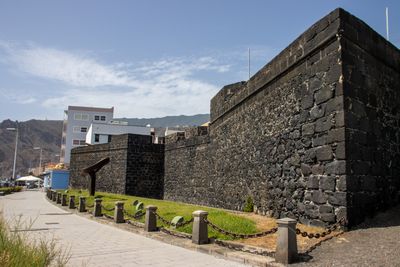
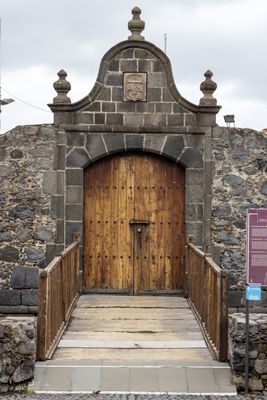
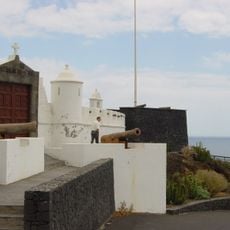
Castle of Santa Catalina is a quadrangular fortress with diamond-pointed bastions at each corner, built in the Italian military Renaissance style. Its walls of rough dark grey and black stone are capped by a flat stone band, and the entrance portal on calle Castillete has a curved gable bearing the coat of arms of the Catholic Monarchs. A wide embankment and moat, crossed by a wooden bridge, surround the castle.
A first castle was built in 1554–1560 after French pirates attacked Santa Cruz de La Palma on 21 July 1553; it was redesigned by Leonardo Torriani in 1585 and demolished after storm damage in the 1660s–1670s. The present castle was built between 1685 and 1692 under Juan Franco de Medina and Miguel Tiburcio Rossell de Lugo, funded by public subscription and the island government. It was declared a Historic Monument in 1951.
The castle is officially the Real Castillo de Santa Catalina and was declared a monumento histórico-artístico in 1951, later listed as Bien de Interés Cultural. Its entrance portal on calle Castillete carries the coat of arms of the Catholic Monarchs, carved in stone above the arched doorway. The site has been privately owned since 1949 and open to visitors since May 2015.
The fortress sits right on the waterfront and is easy to reach on foot from the center of Santa Cruz de La Palma. Sturdy shoes are a good idea, as parts of the site have uneven ground and steps.
The star-shaped design was developed by Italian military engineers and spread across Europe and its colonies during the 16th and 17th centuries. The Canary Islands, as a key stop on transatlantic trade routes, became one of the places where this approach was put to practical use.
The community of curious travelers
AroundUs brings together thousands of curated places, local tips, and hidden gems, enriched daily by 94,426 contributors worldwide.