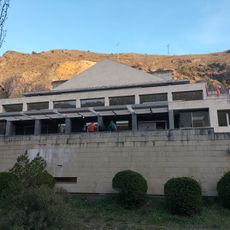
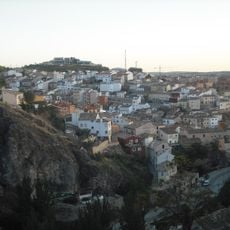
Plaza de toros de Cuenca, bullring in Cuenca, Spain
The plaza de toros de Cuenca is a bullring with tiered seating areas surrounding a sandy central arena where bullfighting events take place. The structure features solid walls, wooden and metal seats arranged in sections, and covered areas that provide shelter during weather changes.
Cuenca had three earlier bullrings before the present one: Pintado (1848), La Perdigana and Caballer, inaugurated on 5 September 1913, where Juan Belmonte fought in 1915. Caballer was demolished in 1920, and the current reinforced-concrete ring opened on 7 September 1926 under mayor Cayo Conversa, with Marcial Lalanda, Valencia II and Martín Agüero on the bill facing bulls from Santa Coloma.
The annual bullfighting fair is held in August in honour of San Julián, the city's patron saint, and gives Cuenca a fixed place in the Spanish bullfighting season. The ring is rated second category and seats 8,500 spectators. Its economic impact reaches two million euros, a figure that has tripled in some years.
The bullring stands on Avenida de los Reyes Católicos, about 900 metres above sea level on the edge of Cuenca's historic centre. Its capacity is 8,500 seats, and the main bullfights are held in August during the Feria de San Julián. The building has corrals and twelve chiqueros, the narrow pens from which the bulls enter the ring.
Manuel Rodríguez "Manolete" made the pasillo, the lap of honour, three times at Cuenca, in 1943 and 1944. The arena also hosted the return to the ring of Jesulín de Ubrique in 2018 and of Cristina Sánchez in 2016.
The community of curious travelers
AroundUs brings together thousands of curated places, local tips, and hidden gems, enriched daily by 93,617 contributors worldwide.