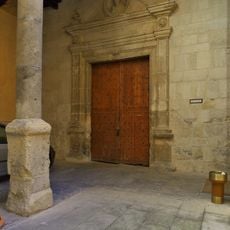
Convent of La Merced in Cuenca, Baroque convent in Cuenca, Spain
The Convent of La Merced is a former Mercedarian monastery built between the 16th and 18th centuries in a predominantly Baroque style. Its church, raised over a crypt because of the uneven ground, has a single nave with a barrel vault pierced by lunettes, an elliptical dome over the transept, and a high choir at the foot. The convent rooms are arranged around a square cloister from the 17th century, which preserves 16th-century masonry walls and an iron grille of the same period.
The Mercedarian Order was founded in the 13th century to ransom Christian captives from territories under Muslim control. The convent in Cuenca later became an important center for this religious mission.
The convent takes its name from the Mercedarian Order, which settled in 1648 in a 16th-century palace built by the Hurtado de Mendoza family; one of its corner towers remains embedded in the present building. The church was still unfinished at the end of the 17th century, and the friars asked the cathedral chapter for money to complete it. Since 1835 the Mercedarians have gone; Esclavas del Santísimo Sacramento nuns now occupy the convent, and the church belongs to the adjoining Seminario Conciliar de San Julián.
The convent stands in the Alcázar neighbourhood, not on Plaza de la Merced. Its church is closed to the public and belongs to the adjoining Seminario Conciliar de San Julián, built in the mid-18th century; the convent itself is occupied by the Esclavas del Santísimo Sacramento community.
The church is closed to the public and now belongs to the adjoining Seminario Conciliar de San Julián, built in the mid-18th century. The convent itself was declared a Bien de Interés Cultural on 4 November 2003.
The community of curious travelers
AroundUs brings together thousands of curated places, local tips, and hidden gems, enriched daily by 95,242 contributors worldwide.