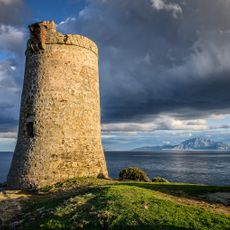
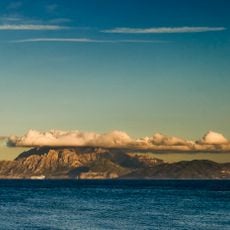
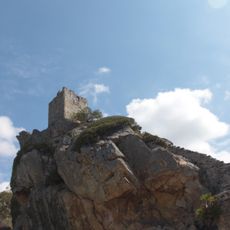
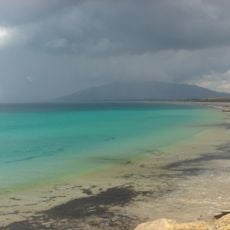
Castillo de Santa Catalina, Military fortress in Tarifa, Spain
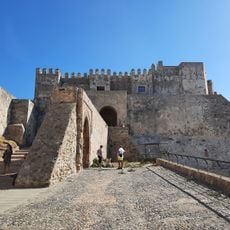
Castillo de Santa Catalina is a 1930s building on the Cerro de Santa Catalina above the port of Tarifa, designed in Renaissance palace style but built with modern materials. It was meant to house a maritime signal semaphore, which was never installed. The building stands abandoned and increasingly deteriorated.
The hill takes its name from a chapel dedicated to Santa Catalina de Siena, known from a 1567 drawing; the chapel became a powder store in 1771 and was demolished by the British during the Peninsular War, who used Tarifa's prisoners as labour and dug a deep dry moat for an artillery fort. In 1926 the Navy chose the summit for a maritime signal semaphore; the hill was ceded to the State in 1928, the project drawn up in 1929, and the building erected between 1930 and 1931 in Renaissance palazzo style, received in 1933 without its semaphore.
The hill takes its name from a former chapel dedicated to Santa Catalina of Siena, known only from a 1567 drawing. Because the site stood apart from the town, it served as a lazaretto during the 17th-century plague epidemic, and in 1771 the chapel became a gunpowder store. The building raised in 1930-1931 was designed in Renaissance style with modern materials, which is why Tarifa residents call it a castle.
The building stands on the Cerro de Santa Catalina near Tarifa's port and old centre, about 6 metres above sea level. It is abandoned and increasingly deteriorated since restoration work was halted by court order in October 2006, so there is no visitor facility or information centre. Neighbourhood associations have denounced its condition.
The building was designed in 1929 in Renaissance style but made with modern materials, and locals nicknamed it "castle" for its palatial look. The semaphore it was meant to house was never installed, and after 1936 bombardments it was declared useless for service in 1937.
The community of curious travelers
AroundUs brings together thousands of curated places, local tips, and hidden gems, enriched daily by 94,548 contributors worldwide.