Castillo de Biniés, Medieval castle in Canal de Berdún, Spain.
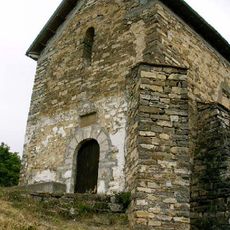
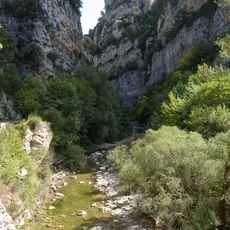
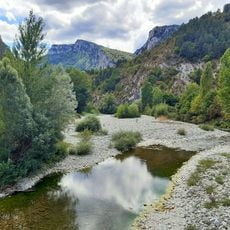
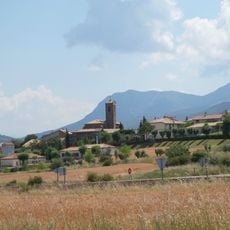
Castillo de Biniés stands north of the village on the edge of the cliff above the Veral River, just past the Foz de Binés. Its rectangular plan encloses an open courtyard, with masonry walls reinforced by cut-stone corners and Renaissance lintel windows, including a large east window that lit the main hall. The oldest tower occupies the northeast corner; a second was added in the 14th century at the southeast, a third with machicolations defended the main entrance, and a fortified wall with machicolations in the northwest corner is considered the fourth tower.
The fortress began as a defensive tower during medieval times to protect the valley below. In the 16th century, the Urriés family renovated it extensively, transforming it into a proper residence.
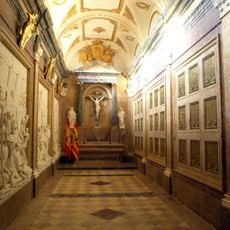
The chapel in the lower floor of the southeast tower has a pointed barrel vault. Its Renaissance murals show octagonal coffers on the vault, square coffers on the altar wall and rusticated stonework opposite. A Latin frieze dated 1583 names Mary Magdalene, though the Gospel of Luke passage refers to Mary of Bethany, a medieval mix-up.
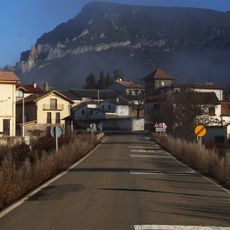
The castle stands at the northern edge of Biniés, on the rim of the cliff above the Veral River just past the Foz de Binés, and its volume rises above the whole village, so it can be seen from every approach to the town. In front of the main west door a small walled space with a well, like a parade ground, is closed by a wide lowered-arch gate opening onto the village. The 20th-century restoration added a wooden gallery along the south wall.
Certain ornate wooden ceilings from the Renaissance period were sold and transported to California, where they were installed in an American mansion. This shows how valuable the family's artworks were and how they traveled across the world.
The community of curious travelers
AroundUs brings together thousands of curated places, local tips, and hidden gems, enriched daily by 93,520 contributors worldwide.