Convento de Santa Clara, Religious convent in Valencia, Spain.
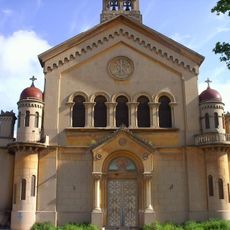
Convento de Santa Clara is a three-storey convent built in Valencian Art Nouveau with medieval historicist influence. Its brick facade surrounds a central courtyard used as a cloister. The church, in Neoclassical style, has a single nave and is entered through a small patio; it is the only part open to visitors.
The convent was built in 1911 to designs by Ramón Lucini Callejo, a Leonese architect settled in Valencia, for the Capuchin Clarisses, who moved in in 1913. The site then lay on the outskirts in the Tránsitos district, surrounded by market gardens, to favour the nuns' contemplative life. During the Spanish Civil War the Republican side used it as a men's prison; from June 1939 to April 1942 it was a women's prison, a branch of the Provincial Women's Prison, guarded by the nuns together with officials of the Sección Femenina.
The building combines Valencian Art Nouveau style with medieval influences, creating a neoclassical church with a single nave. These design choices shape how the space looks and feels to visitors today.
The building is located at Avenida Pérez Galdós 119 and has restricted public access. Visitors can enter the church through a small entrance patio, but most other areas remain closed to the public.
The convent is the seat of the "Madre de Dios" Federation of Capuchin Poor Clares for eastern Spain. Brides and falleras keep a local custom: leaving eggs at the convent is believed to keep rain away on the day of a wedding or a falla event.
The community of curious travelers
AroundUs brings together thousands of curated places, local tips, and hidden gems, enriched daily by 93,639 contributors worldwide.