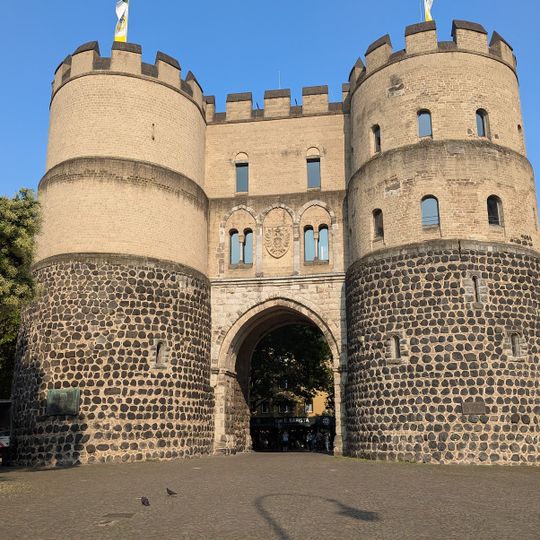
Hahnentorburg, Medieval fortified gate in Cologne, Germany
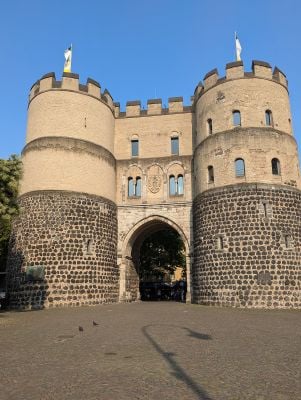
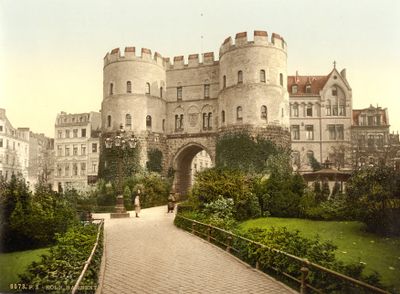
The Hahnentorburg is a double-towered gate of light grey and brown stone at Cologne's Rudolfplatz, with a pointed archway, crenellated towers and a dark wooden gallery above the central section. Its lower walls are faced with a grid of small dark stones. Since 1988 it has housed the EhrenGarde carnival society and a rentable casino.
First mentioned in 1264, the gate served as the ceremonial entrance for German kings returning from their coronation in Aachen to visit Cologne Cathedral. After most of the city walls were demolished in 1881, it became one of only four medieval gates still standing.
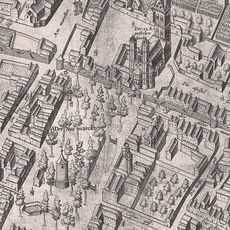
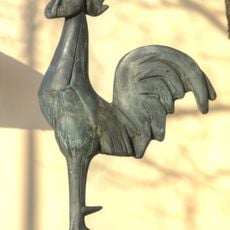
The name's origin is uncertain: it may come from the 12th-century landholder Hageno von Anselm, or from Hano, meaning grove, for the woods along the road to Aachen. It appears as Hanenpforts on Arnold Mercator's 1570 view of Cologne and as Porte du Coq on the 1808 Tranchot map. Since 1988 the EhrenGarde carnival society has been based here.
The gate stands on Hahnenstraße at Rudolfplatz, in the Altstadt-Süd, where the tram stop of the same name marks the spot. The interior is rented out as a casino and is home to the EhrenGarde carnival society, so it is not open as a museum; the field side with its arch, ivy-covered bases and the 1888 restoration inscription below the eagle crest is what you see from the street.
On the tower roofs, replicas of medieval throwing machines were once placed so they could be seen from afar, after Josef Stübben restored the gate around 1890. The left half-tower on the field side was largely destroyed in the Second World War. Since 1988 the gate has housed the EhrenGarde carnival society and a rentable casino.
The community of curious travelers
AroundUs brings together thousands of curated places, local tips, and hidden gems, enriched daily by 93,118 contributors worldwide.