Herford Abbey, Former women's abbey in Herford, Germany
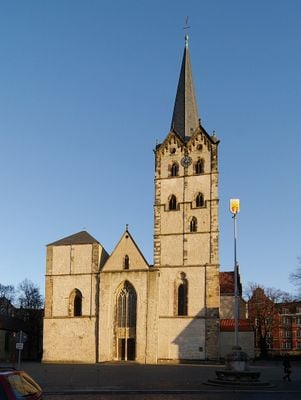
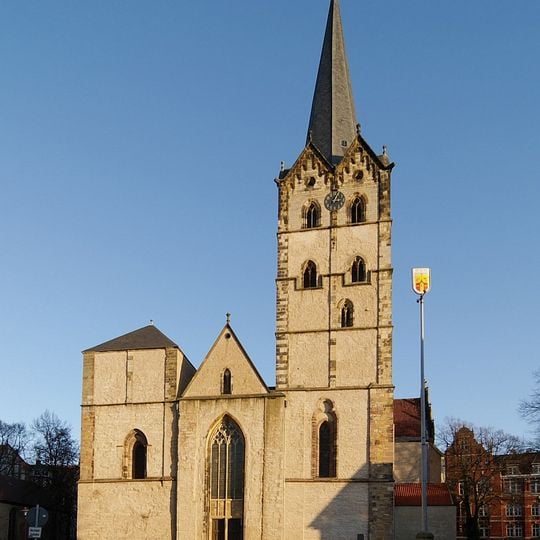
Herford Abbey was a secular canonesses' foundation, not a Benedictine monastery, dedicated to Saints Mary and Pusinna. Its former abbey church, now Herford Minster, is a tall stone building in light beige and grey masonry with a broad lower body on the left and a dominant tower on the right, topped by a steep dark grey spire. The tower face has tall narrow arched windows and two round clock faces near the upper level; the lower section has a plain gabled roofline, one arched side window, and a large pointed-arch window with tracery at its front.
The monastery was founded in 789 by the nobleman Waltger and relocated to its present location around 800. It later became an Imperial abbey under Emperor Louis the Pious, granting it greater power and influence.
The former abbey church is now Herford Minster, not a cathedral. The abbey was dedicated to Saints Mary and Pusinna, whose relics were brought here in 860. In 1533, during the Reformation, the abbey became Lutheran under the Electors of Brandenburg; from 1649 its abbesses were Calvinist for over a century, while the principality stayed Lutheran.
The abbey complex is accessed through Logenplatz 4, where visitors can walk through the preserved medieval buildings and grounds. It is best to visit outside of service times to explore the structures without interruption.
Pusinna was not a virgin martyr but a hermit at Binson, near Châlons-en-Champagne; Abbess Haduwy had her bones brought to Herford in 860, after which the house was dedicated to Saints Mary and Pusinna. The relics made Herford a pilgrimage centre and gave the abbey its second patron.
The community of curious travelers
AroundUs brings together thousands of curated places, local tips, and hidden gems, enriched daily by 93,608 contributors worldwide.