Andechs Abbey, Benedictine monastery in Bavaria, Germany
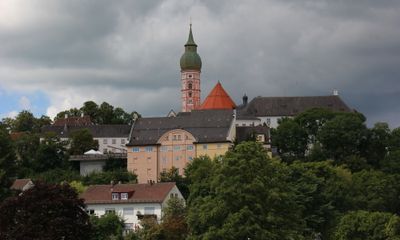
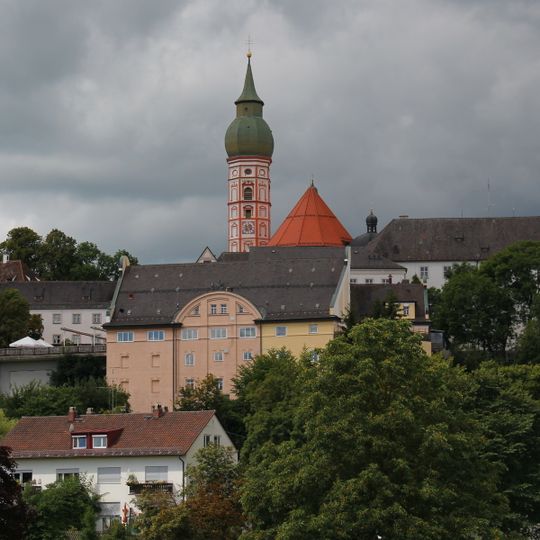
Andechs Abbey is a Benedictine monastery on a hill east of the Ammersee in Upper Bavaria. Its tall bell tower, pale pink with white trim, arched openings and a clock face, carries a green onion dome and stands before a steep orange-red pyramidal roof. The main church has a long dark grey hipped roof above a pinkish-beige facade with a rounded central gable, pilasters and rows of rectangular windows; a long white building with a grey roof stretches behind the tower, and dense trees surround the base.
Around 1100 Berthold II, Count of Andechs, built a residence on the hill; his line died out in 1248 and the castle decayed. In 1388 a relic hoard was found beneath the old castle chapel, reviving pilgrimage, and in 1423–1427 the canons of Dießen built a three-aisled late-Gothic hall church. Duke Albrecht III turned the foundation into a Benedictine monastery in 1455; a lightning strike on 3 May 1669 burned almost everything, and the Baroque rebuild by Marx Schinnagl was finished by 1674. Dissolved in 1803, it was refounded in 1850 as a priory of St Bonifaz in Munich.
The abbey's name comes from the Counts of Andechs, whose castle stood here until the line died out in 1248. Pilgrims still come for the relics rediscovered in 1388, including the three hosts; since 1943 Hedwig pilgrimages have been held with the saint's skull relics. The monks run a summer organ festival, the Carl Orff Festival and symposiums, and fund homeless aid in Munich from brewery proceeds.
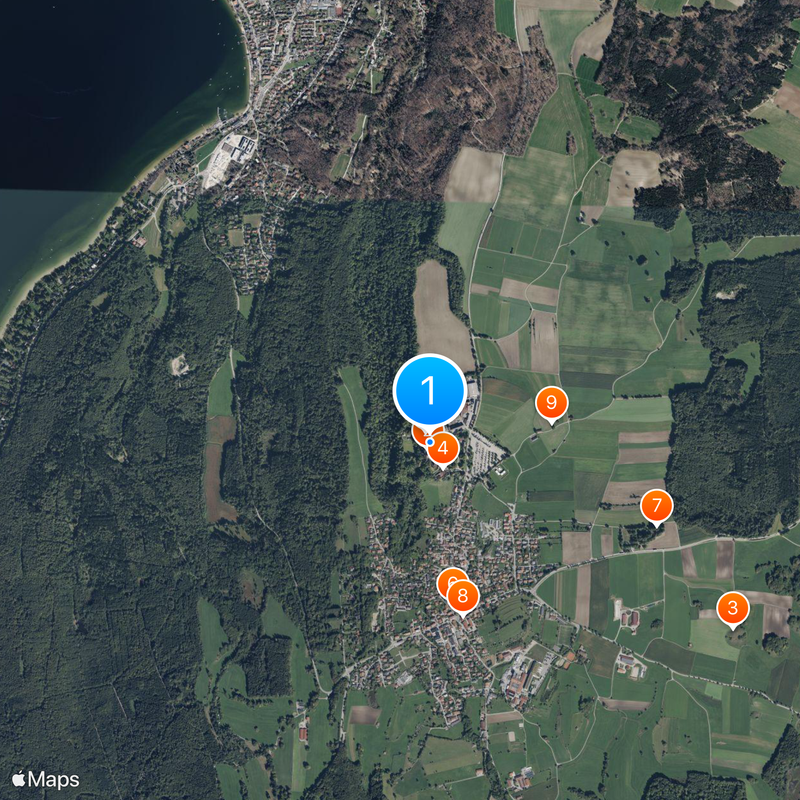
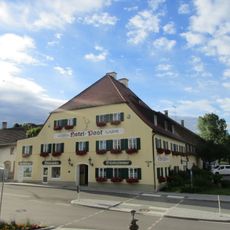
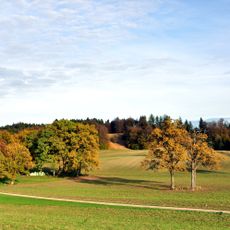
The abbey sits on a hill east of the Ammersee; the church, the Klostergasthof with its beer garden and the Bräustüberl are reached on foot from the parking areas below. The site is a working monastery, so the church may be closed to visitors during services. The church and monastery buildings are not wheelchair accessible.
Carl Orff, composer of Carmina Burana, is buried in the abbey church, and eleven members of the House of Wittelsbach lie there too, mostly from the 15th and 16th centuries. Since the Munich Theatine crypt ran out of space, Albrecht, Duke of Bavaria, laid out a burial ground for the former royal family in the abbey garden in 1977.
The community of curious travelers
AroundUs brings together thousands of curated places, local tips, and hidden gems, enriched daily by 93,418 contributors worldwide.