Alte Nahebrücke, Medieval stone bridge in Bad Kreuznach, Germany
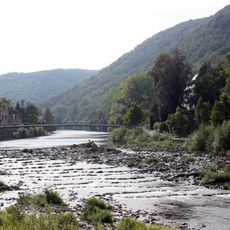
The Alte Nahebrücke is a stone arch bridge spanning the Nahe River and Mühlenteich canal in Bad Kreuznach with eight arches made of sandstone and porphyry stone. It crosses the water for about 135 meters and supports four residential buildings on its upper surface.
Construction began around 1300 under Simon II, Count of Sponheim-Kreuznach, to link settlements and form a crucial route between Mainz and Trier. German troops detonated the river-crossing section in March 1945, after which a concrete structure replaced the damaged arches in 1956.
The four half-timbered bridge houses on Mannheimer Straße were built between 1582 and 1612 and first recorded in 1495. Craftsmen and merchants lived in them; today they house shops and businesses. A cannonball fired by Swedish troops in 1632 during the Thirty Years' War is still lodged in the facade of house No. 94.
The bridge is accessible via Mannheimer Straße and has footpaths between 2 and 3 meters wide on both sides alongside the 6-meter-wide road. Access is straightforward from the old town, and crossing is easy for pedestrians and cyclists.
The river section of the bridge was so damaged by the end of the war that it was not restored but replaced with concrete in the 1950s. This means pedestrians today walk over a modern middle section while crossing on historical stone arches at the sides.
The community of curious travelers
AroundUs brings together thousands of curated places, local tips, and hidden gems, enriched daily by 93,292 contributors worldwide.