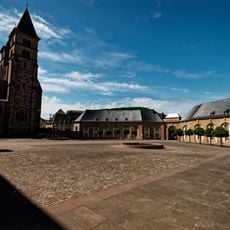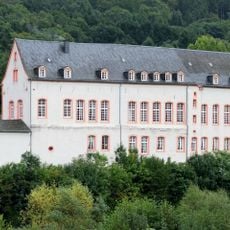
Devil's Gorge, Natural valley formation in Eifel region, Germany
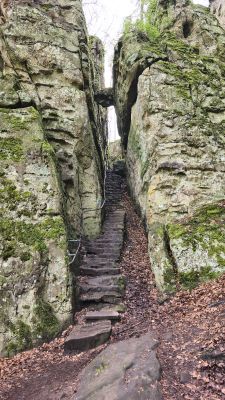
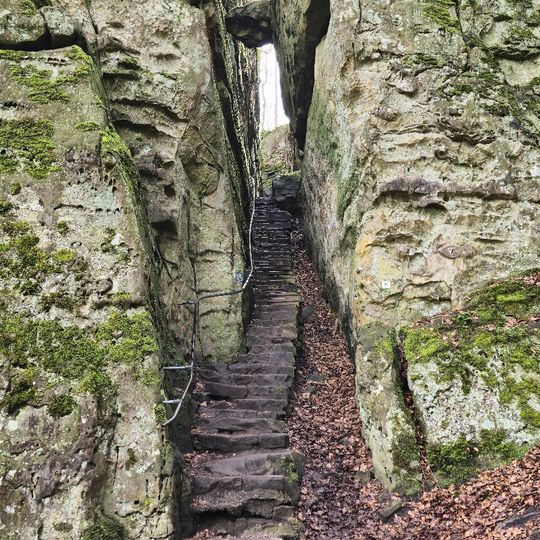
Devil's Gorge is a rock fissure 1 to 5 metres wide on the eastern edge of the Ferschweiler Plateau near Irrel. Its walls are Luxembourg Sandstone from the Lower Jurassic, laid over impervious keuper beds. A dark stone path with steps climbs between the grey-green, weathered walls, which converge into a narrow V-shaped gap overhead.
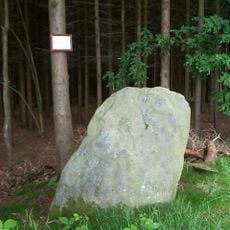
The gorge formed about 10,000 years ago, at the end of the last ice age, through one or more rock collapses. The cause was the undercutting of fissured, porous Luxembourg Sandstone (Lower Jurassic) where it rests on watertight Keuper beds, combined with extensive frost shattering. Boulders on the slopes of the Ferschweiler Plateau still mark those rock displacements.
The name Teufelsschlucht, "Devil's Gorge", is a popular label rather than a documented tradition; the sources record no legend behind it. What visitors can see today is the gorge used as a starting point for walks on the Ferschweiler Plateau, including the route to the Irreler Waterfalls, largely destroyed by the storms of 2021.
Three circular walking trails guide visitors through the gorge and surrounding rocky landscape, with lengths between 2 and 6 kilometers. Wear sturdy footwear and expect uneven ground and sections that can be slippery.
The gorge is a rock fissure only 1 to 5 metres wide, created directly by one or more rock collapses at the end of the last ice age. Boulders scattered on the slopes of the Ferschweiler Plateau are the debris of those collapses, still lying where they fell.
The community of curious travelers
AroundUs brings together thousands of curated places, local tips, and hidden gems, enriched daily by 94,593 contributors worldwide.