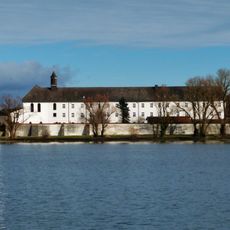
Frauenchiemsee, Historic Benedictine island in Lake Chiemsee, Bavaria, Germany
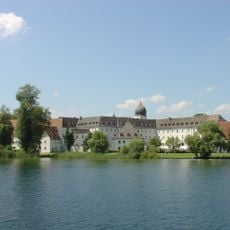
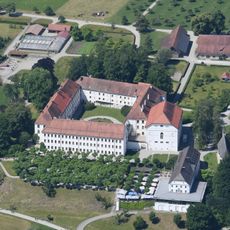
Frauenchiemsee is a 15.5-hectare car-free island in Lake Chiemsee, home to about 200 residents in some 50 houses and to the Benedictine convent of Frauenwörth. A long pale-walled wing with a red tiled roof runs near the water, connected to taller white buildings with red roofs. Behind them rises the white island church with its dome and a tall tower topped by a dark cupola; further back, on higher ground, a large white building with a long red roof faces an open green field.
Duke Tassilo III founded the convent in 782, making it the oldest German-speaking women's convent beyond the Alps; in the Notitia de servitio monasteriorum it appears as Schönau. Irmengard, its first known abbess, died in 866 and is venerated as the patroness of the Chiemgau. After Hungarian raids the house flourished between the 11th and 15th centuries, and from 1254 the Bavarian dukes held its rights. Secularised in 1803, it was re-established by King Ludwig I in 1836 on condition that the nuns run schools.
The nuns of Frauenwörth still distil a herb liqueur, the monastery's best-known product, sold on the island. The convent is a pilgrimage site for Blessed Irmengard, patroness of the Chiemgau, and the island has drawn painters since the Chiemsee artists' colony was founded in 1820, Max Haushofer among them.
The island is reached only by boat from the mainland since it is car-free and served by regular ferry services from several ports. Visiting is possible year-round, with walking around the island being straightforward and requiring no special physical demands.
Inside the convent church there is a wall displaying photographs of babies born after their parents visited Saint Irmengard. Pilgrims seek out the saint hoping for help with having children.
The community of curious travelers
AroundUs brings together thousands of curated places, local tips, and hidden gems, enriched daily by 93,263 contributors worldwide.