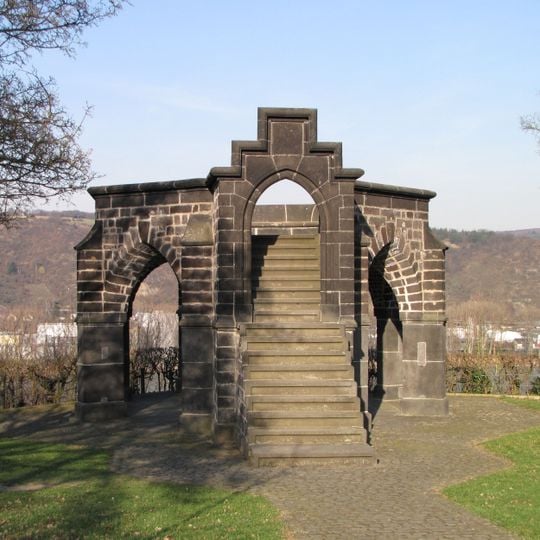
Königsstuhl, Stone throne monument in Rhens, Germany
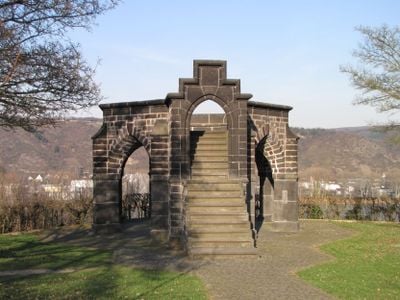
The Königsstuhl is a two-storey octagonal stone structure modelled on an enlarged throne, with seven pointed arches opening onto a vaulted loggia around an octagonal central column. A straight flight of 17 steps rises through an arched gateway with a stepped gable to the upper platform. It is built of black lava blocks, with basalt for the eight outer columns and the central column.
From 1273 onward, the site served as a meeting place for prince-electors to select German kings until the structure was destroyed in 1795 during the Napoleonic Wars. The current reconstruction was built in 1842 based on remnants and plans from the original building.
The name Königsstuhl means "King's Chair", and the structure was built as an enlarged stone throne. Since 1978 the mayors of Koblenz and Rhens have met here at Pentecost, and for many years the mayor of Koblenz received his official chain at the monument.
The monument sits along the B9 road near Rhens and remains open year-round with no entrance fees required. Parking spaces are directly across from the site, making access straightforward for visitors.
The structure visitors see is not in its original spot: in 1929 it was moved to the Schawall hill beside the B9 road, and a memorial plaque marks the old site. The 1841–1843 rebuild was by Johann Claudius von Lassaulx, financed by a collection sparked by Karl Bernhard Hundeshagen's 1826 New Year plaque showing the throne in relief.
The community of curious travelers
AroundUs brings together thousands of curated places, local tips, and hidden gems, enriched daily by 94,648 contributors worldwide.