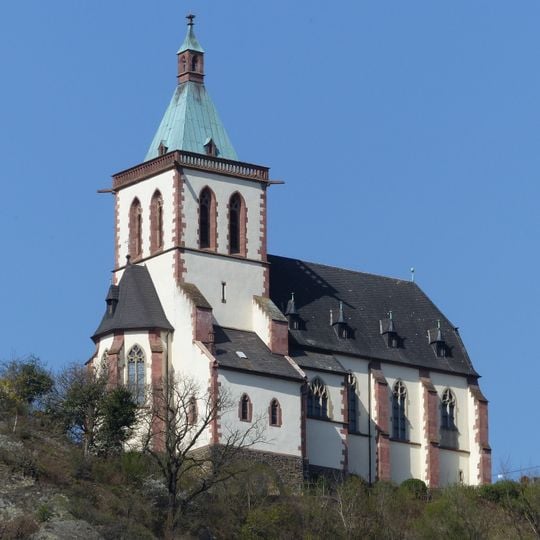
Allerheiligenbergkapelle, Gothic Revival chapel on hill in Lahnstein, Germany
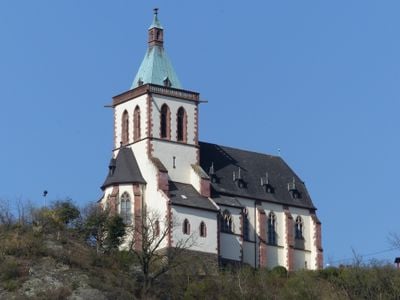
The Allerheiligenbergkapelle is a Gothic Revival church with a choir tower on a 170-metre hilltop near Niederlahnstein. Its white plastered walls carry reddish-brown stone trim around the pointed-arch windows, corners and roofline; a tall square tower on the left ends in a steep pale green pyramidal spire with a small lantern and cross. A lower body with a dark grey pitched roof and paired pointed-arch windows extends to the right, with a smaller side projection under its own conical roof.
The chapel was built between 1895 and 1901 under architect Max Meckel's direction. It was created as a memorial for soldiers who died during the conflict of 1870 to 1871.
The chapel is dedicated to All Saints, a feast that since 1690 has been linked to this hilltop, where Johann Philipp Trarbach built a chapel and hermitage in honour of the Holy Trinity, the Virgin Mary and all saints. The baroque Madonna of the Rosary from the earlier chapel hangs in the choir, and the high altar shows Mary handing a rosary to Saint Dominic. The Hünfelder Oblates cared for the chapel from 1919 until autumn 2012.
Visitors reach the chapel through a 1.2 kilometer (0.75 mile) pilgrimage path marked with several small chapels along the route. The path climbs steeply uphill, so appropriate footwear and extra time are recommended.
Behind the choir, on the chapel's west side, stands a Crucifixion group carved in 1901 by the Lahnstein sculptor Caspar Weis (1849–1930). The Holy Sepulchre in the grotto below came from his workshop and was donated by the Lahnstein entrepreneur family Christian Sebastian Schmidt. Both were restored between 1987 and 1989.
The community of curious travelers
AroundUs brings together thousands of curated places, local tips, and hidden gems, enriched daily by 93,069 contributors worldwide.