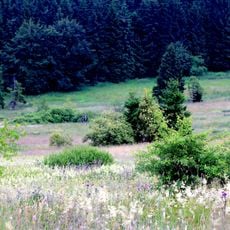
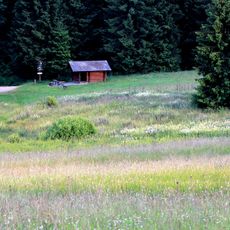
Bromacker, Paleontological site and quarry near Tambach-Dietharz, Thuringia, Germany
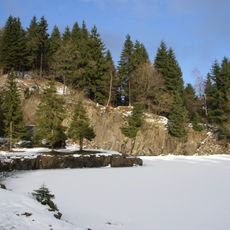
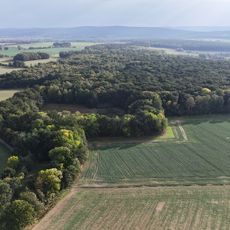
Bromacker is a paleontological excavation site in the Thuringian Forest where fossils from the early Permian period are carefully extracted. The specimens date back roughly 290 million years and preserve three-dimensional remains of ancient vertebrates.
The fossil site was discovered in 1974 by the German paleontologist Thomas Martens. Since then, German and American paleontologists have excavated more than 40 skeletons of about 12 species of early reptiles, along with numerous insect and plant fossils. After about a decade without regular systematic digs, the five-year BROMACKER research project began in 2020, run by the Berlin Museum für Naturkunde with the Friedenstein Castle Foundation Gotha, the University of Jena and the UNESCO Global Geopark Thüringen Inselsberg – Drei Gleichen.
The quarries are named after the Bromacker slope in the Apfelstädt valley, though they lie on Georgenthal municipal land, not in Tambach-Dietharz. Since 2020 the BROMACKER project, run by Berlin's Museum für Naturkunde with Gotha's Friedenstein foundation, Jena university and the UNESCO Geopark Thüringen Inselsberg – Drei Gleichen, has emphasised dialogue with interested laypeople.
The site has areas where visitors can observe active fieldwork, which operates separately from commercial quarrying operations. Discovered fossils are transported to the Museum der Natur Gotha for documentation and preservation.
Among the finds is a regurgitated pellet, likely from Dimetrodon or Tambacarnifex, holding 41 bones including remains of Thuringothyris and Eudibamus; it is considered the oldest such trace from a terrestrial setting. The resting trace Bromackerichnus, preserved on the undersides of bedding planes, is likewise unusual.
The community of curious travelers
AroundUs brings together thousands of curated places, local tips, and hidden gems, enriched daily by 94,048 contributors worldwide.