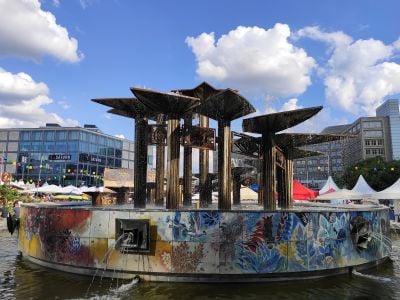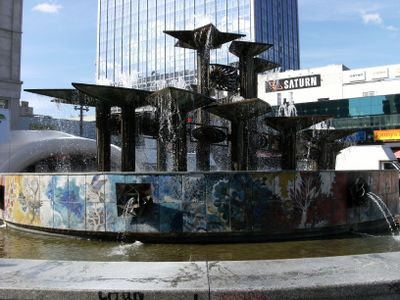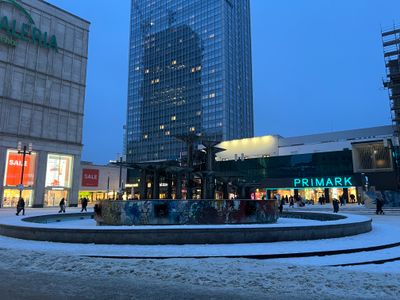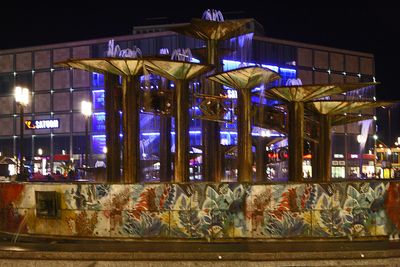
Brunnen der Völkerfreundschaft, Ornamental fountain at Alexanderplatz, Berlin, Germany
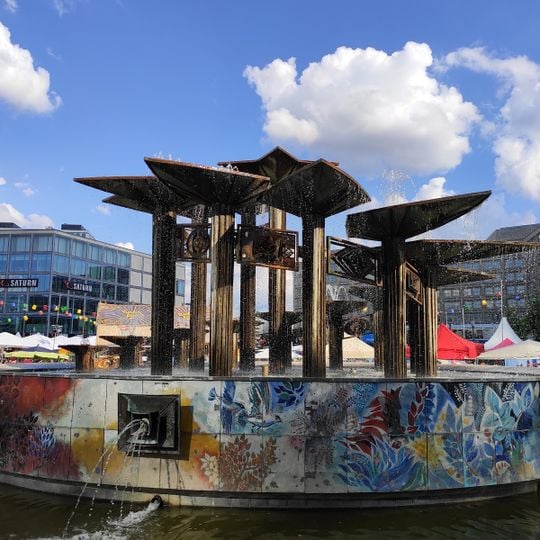
The Fountain of Friendship between Nations is a fountain on Alexanderplatz in Berlin-Mitte, built in 1969–1970 to a design by Walter Womacka and executed by Hans-Joachim Kunsch. It is 6.20 metres high and 23 metres in diameter, with a smaller upper basin and a larger lower basin. Seventeen leaf-shaped bowls on columns descend in a spiral; water flows from them into the upper basin and through eight flower-shaped outlets into the lower basin. The outer rim carries a frieze of animal and plant motifs in copper, ceramic, glass and enamel.
Walter Womacka designed the fountain in 1969–1970, with Hans-Joachim Kunsch carrying out the construction. It was unveiled on 7 October 1970, the 21st anniversary of the founding of the GDR, between the Centrum department store, the Hotel Stadt Berlin and the Berolinahaus. It has been a protected monument since the 1980s and was extensively restored in 2022.
East Berliners nicknamed the fountain "Nuttenbrosche" (prostitute's brooch) because of its bright enamelled colours and the prostitution nearby. Its official name refers to friendship among nations, and the tiled frieze of animals and plants carries that theme around the upper basin.
The fountain sits on a large public square in central Berlin with good public transport connections nearby. Visitors can freely walk around and view it at any time without barriers, fees, or specific operating hours.
Water flows through 17 progressively deeper basins before falling into a larger lower basin. This cascading arrangement was an unusual engineering choice for a public square in the 1970s.
The community of curious travelers
AroundUs brings together thousands of curated places, local tips, and hidden gems, enriched daily by 94,101 contributors worldwide.