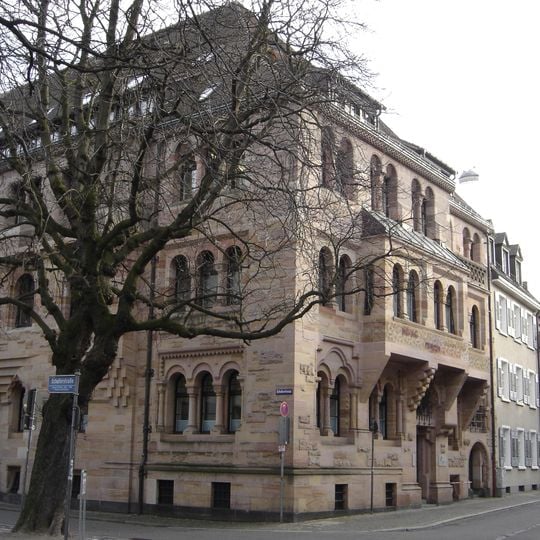
Erzbischöfliches Ordinariat Freiburg, Administrative building of the Archdiocese of Freiburg in Freiburg im Breisgau, Germany
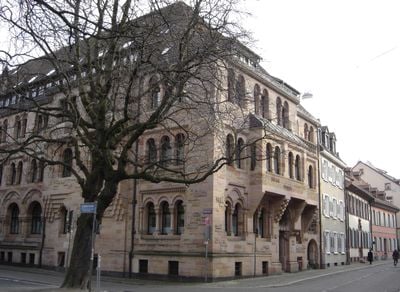
The Erzbischöfliches Ordinariat Freiburg is the administrative seat of the Archdiocese of Freiburg, built 1903–1906 to plans by Raimund Jeblinger and clad in Landstuhl sandstone. Its late Historicist facades combine Late Romanesque and Byzantine elements with Jugendstil ornament; the corner and lower walls carry projecting strips of masonry with carved chevron patterns, and round-arched windows sit in recessed surrounds. A columned entrance porch faces Schoferstraße.
The site held the Augustinian monastery of All Saints from 1700 until it was dissolved in secularization; its buildings later served as a military hospital from 1851 and a barracks from 1871. After the Catholic Church bought the land in 1902, the monastery was demolished. Raimund Jeblinger's plans began in 1900; foundations were laid in June 1903, the roof was set in December 1904, and Archbishop Thomas Nörber consecrated the building in November 1906. A bomb hit in February 1945 forced renovation that altered the facade and roof.
The building is the administrative seat of the Archdiocese of Freiburg, an ecclesiastical authority rather than a parish church. Its interior painting was done by the Freiburg artist Franz Schilling. Coloured and gilded ornaments planned by Jeblinger for the exterior were restricted to the interior after objections from the cathedral chapter.
The main entrance is at Schoferstraße, opposite the Collegium Borromaeum and near the Münster. From 1933 to 2005 visitors entered via Herrenstraße, bypassing the richly decorated main staircase; since January 2006 the original Schoferstraße entrance has been used again. The building is in the city centre, within walking distance of public transport stops.
The interior murals were painted by the Freiburg artist Franz Schilling. Jeblinger had planned coloured and gilded ornaments for the exterior too, but objections from the cathedral chapter kept them inside. From 1933 to 2005 visitors entered through Herrenstraße and so missed the richly decorated main staircase; since January 2006 the original Schoferstraße entrance is used again.
The community of curious travelers
AroundUs brings together thousands of curated places, local tips, and hidden gems, enriched daily by 94,930 contributors worldwide.