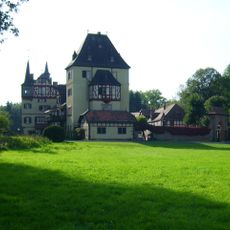
Brücker Mühle, Historic watermill in Amöneburg, Germany.
Brücker Mühle is a watermill in Amöneburg that stands where the Ohm River meets its old watercourse and operates two Francis turbines for power generation. The facility combines energy production with a natural food shop serving the local community.
First mentioned in 1248 as molendinum in Brucke, the mill belonged to Amöneburg and the Archbishopric of Mainz. It was destroyed during the Mainz-Hesse conflicts of the early 15th century and again in the Thirty Years' War, then rebuilt with two-metre-thick walls. On 21 September 1762 the bloodiest battle of the Seven Years' War in Upper Hesse took place here, with 527 dead and 1,363 wounded; on 15 November 1762 a truce was signed in the mill, commemorated by the Friedenstein obelisk.
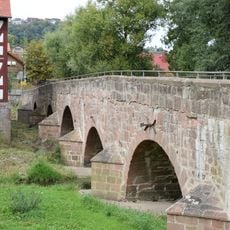
The mill's name comes from the vanished settlement of Brück, whose stone bridge over the Ohm stood by the medieval trade routes of Cologne–Leipzig and Frankfurt–Hannover; street names "Im Brück" and "Brücker Kirchweg" still recall it. For centuries the miller was allowed to serve beer to travellers, mashing malt ground in the mill. Today the mill and the 1752 Brücker Wirtshaus next door house a wholefood shop and an organic restaurant.
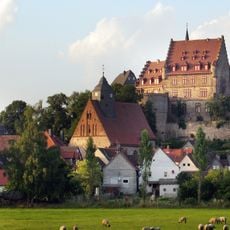
The mill stands at the southeastern foot of the Amöneburg rock, just before the Ohm meets its old left arm, the Alte Ohm. A driveway bridge from the direction of Amöneburg crosses the Alte Ohm onto the mill yard. The mill can be visited during business hours; the buildings now hold an organic shop and an organic restaurant.
The 1663 engraving by Matthäus Merian the Younger shows the mill as a fortified stone castle with two tall towers on the south side and three mill wheels on the east side. Two-metre-thick stone walls from this period still stand in the entrance area.
The community of curious travelers
AroundUs brings together thousands of curated places, local tips, and hidden gems, enriched daily by 93,240 contributors worldwide.