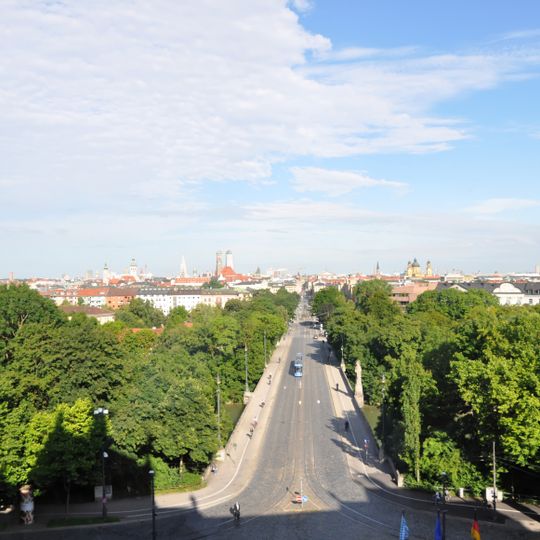
Maximilian Bridge, Road arch bridge over the Isar in Lehel, Munich, Germany
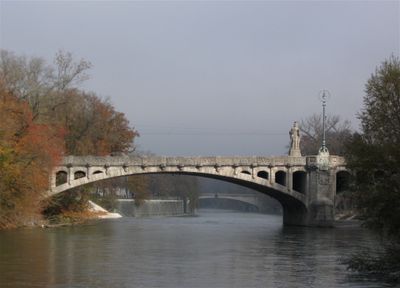
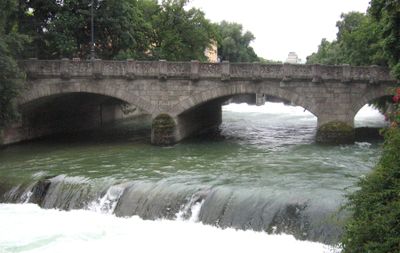
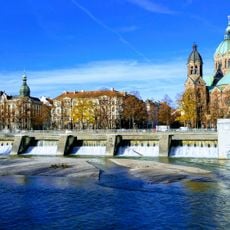
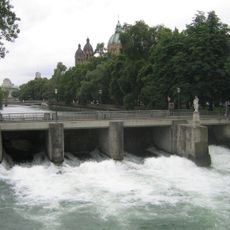
Maximilian Bridge is a road arch spanning the Isar River, connecting Munich's Lehel district with other parts of the city and built from concrete and limestone. The structure stretches about 138 meters and carries both vehicle and pedestrian traffic across the river.
The bridge was built between 1857 and 1863 as an extension of Maximilianstraße to the Maximilianeum, designed by Arnold Zenetti. Both spans were only 13 m wide against the street's 23 m. In 1903–1905 Friedrich von Thiersch and the firm Sager & Woerner widened the inner span over the Große Isar and rebuilt the outer span over the Kleine Isar and Auer Mühlbach. It is named after King Maximilian II and was restored in 1989.
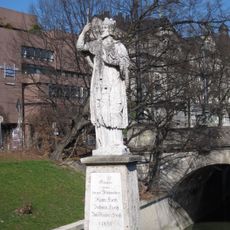
The bridge is named after King Maximilian II of Bavaria. On the Äußere Maximiliansbrücke stands a statue of Pallas Athena, unveiled in 1906, by sculptor Franz Drexler; the architect's daughter Frieda Thiersch modelled for it. The bridge carries trams, cars, cyclists and pedestrians on a 22-metre-wide deck.
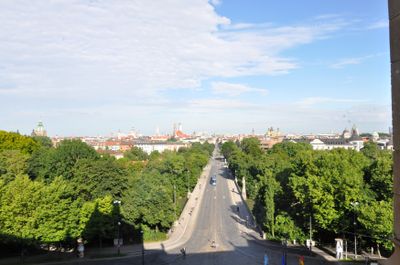
The bridge carries trams, cars, cyclists and pedestrians on a 22 m wide deck, with a raised walkway along one side marked by a low wall and short posts. The Inner Maximiliansbrücke links the Lehel bank to the Praterinsel, the Outer one continues from the island over the Kleine Isar and the Auer Mühlbach to the Maximilianeum.
On 27 June 1904 the hinges of one nearly finished three-hinged arch of the Outer bridge slipped at the abutments and the arch dropped about 30 cm; the second arch followed. The arches were lifted back with spindles and set on improved hinges. The 1906 statue of Pallas Athene by Franz Drexler used Frieda Thiersch, the architect's daughter, as model.
The community of curious travelers
AroundUs brings together thousands of curated places, local tips, and hidden gems, enriched daily by 93,454 contributors worldwide.