Heisterbach Abbey, Cistercian monastery ruins in Königswinter, Germany
Heisterbach Abbey is a former Cistercian monastery in Königswinter whose ruined church retains only the apse and choir. The late Romanesque church, consecrated in 1237, was 88 metres long and 44 metres wide; its ambulatory with a ring of chapels doubled the columns between walkway and choir. A neo-Gothic mausoleum designed by Ernst Friedrich Zwirner stands in the English landscape garden laid out after 1820.
Twelve Cistercian monks from Himmerod Abbey, sent by Archbishop Philip of Cologne, took over the deserted Augustinian monastery on the Petersberg on 22 March 1189 under Abbot Hermann. In 1202 they moved down into the Peterstal, where the foundation stone of the new abbey was laid; the church, 88 metres long, was consecrated on 18 October 1237. After the abbey was dissolved in 1803, the church was sold in 1809 and demolished, its stones used for the Nordkanal and later Ehrenbreitstein Fortress; only the choir apse survived.
The name Heisterbach comes from "Heister", a young beech stem, referring to the beech woods of the valley. The abbey was also called Petersthal, and from 1211 "Maria im Peterstal in Heisterbach"; the name appears on a coat of arms above the entrance gate. Caesarius of Heisterbach (1180–1240), the abbey's best-known monk, wrote down a legend of a monk who slept 300 years in the forest, versified by Karl Wilhelm Müller (1813–1894).
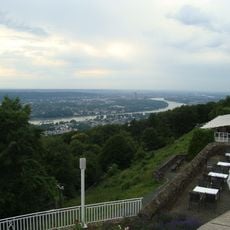
The choir ruin and the surrounding English landscape garden, laid out from 1820, are open to visitors. The baroque gatehouse of 1750 and the neo-Gothic mausoleum built in 1840 to designs by Ernst Friedrich Zwirner stand on the grounds. The site lies in the Heisterbach valley between Oberdollendorf and Heisterbacherrott.
The 1237 church was 88 m long and 44 m wide, the largest church in the Rhine Valley after the Romanesque Cologne Cathedral. Its ambulatory doubled the columns between walkway and choir, an unusual take on the two-shell apse. Caesarius of Heisterbach (c. 1180–1240) was a monk here, and a monument to him was put up near the ruins in 1897.
The community of curious travelers
AroundUs brings together thousands of curated places, local tips, and hidden gems, enriched daily by 93,266 contributors worldwide.