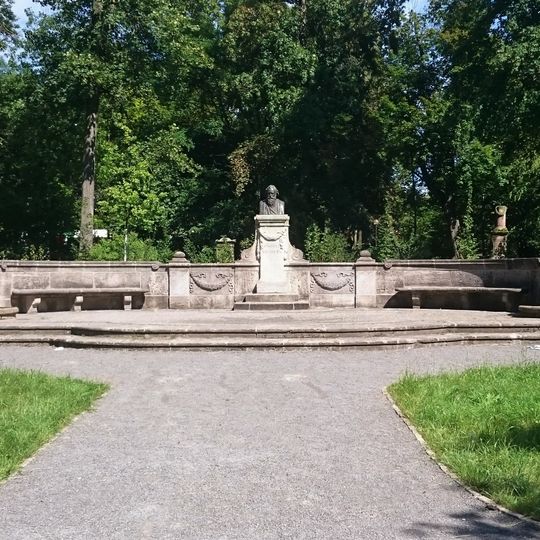
Brahms-Denkmal, Bronze memorial in English Garden, Meiningen, Germany
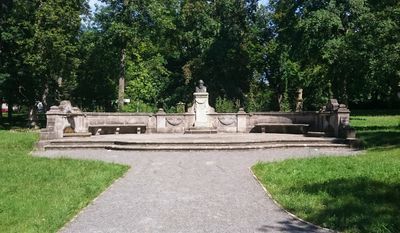
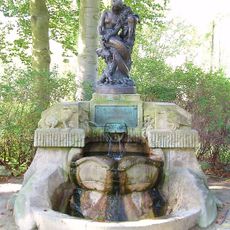
The Brahms-Denkmal is a bronze bust of Johannes Brahms on a tall limestone pedestal, set within a semicircular exedra of limestone panels carved with garland motifs. Stone benches flank the pedestal, and a paved terrace reached by a broad two-step stair holds a mosaic wind rose of limestone, anthracite basalt and red sandstone. Fountains with stone basins close both ends.
The memorial was funded by Meiningen music lovers at the suggestion of court conductor Fritz Steinbach and created in 1898/99 by Munich sculptor Adolf von Hildebrand. It was unveiled on 7 October 1899, making it the first monument to Brahms erected in Germany after his death. For the ceremony, Josef Viktor Widmann wrote a 64-line prologue.
Brahms wrote three works for the Meiningen clarinettist Richard Mühlfeld, and the court orchestra under Fritz Steinbach gave his Fourth Symphony its premiere here on 25 October 1885. The memorial was funded by Meiningen music lovers on Steinbach's initiative, and for the unveiling on 7 October 1899 Josef Viktor Widmann wrote a 64-line prologue.
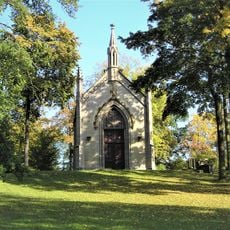
The memorial stands on a side path in the southeastern English Garden, next to the old cemetery and the Ducal Crypt Chapel. The paved terrace is reached by a broad, gently curved two-step stair; stone benches flank the pedestal. The site is a heritage monument, so the terrace and steps are not step-free.
The terrace mosaic is a compass rose made of three named stones: light limestone, anthracite-coloured basalt and red sandstone. It lies inside the exedra, reached by a broad, gently curved two-step stair. The semicircular forecourt in front of the monument is a separate paved area.
The community of curious travelers
AroundUs brings together thousands of curated places, local tips, and hidden gems, enriched daily by 94,897 contributors worldwide.