Burg Landshut, Medieval castle ruins in Bernkastel-Kues, Germany.
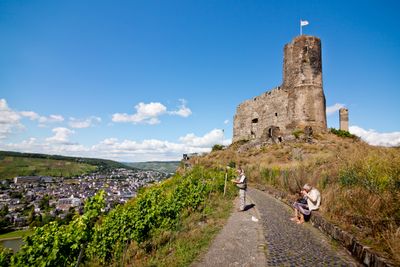
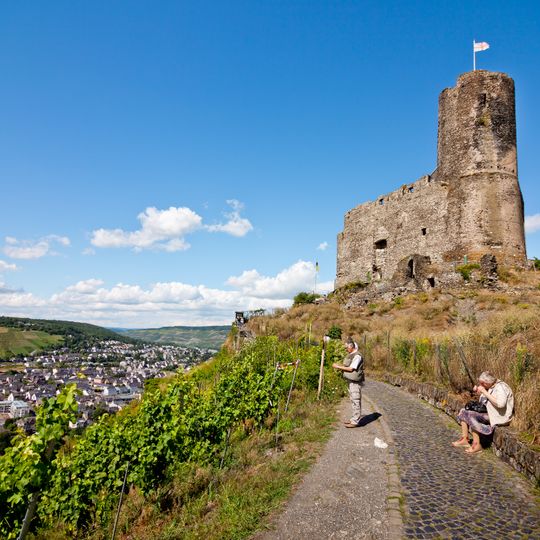
Burg Landshut is a ruined hilltop castle above Bernkastel-Kues, built on the foundations of a 4th-century Roman fort. Its walls of rough grey and brown masonry follow the rectangular outline of that fort, about 60 by 30 metres. A tall cylindrical tower stands on the right, with lower broken walls to its left, and a flagpole rises from the tower.
A late Roman fort with 1.8-metre quartzite walls and six or seven square towers stood here in the 4th century. The medieval castle was built at the end of the 13th century by Trier archbishop Heinrich von Finstingen on those foundations. In 1280 the counts of Salm sold castle and bailiwick to Trier, and in 1505 the name Landshut first appears. A fire on 8 January 1692 destroyed it; it was never rebuilt and has belonged to the town since 1920.
The name Landshut appears in Trier electoral records only in 1505; before that the castle was called Bernkastel, after the settlement below. It housed an Amtmann who governed the surrounding lands for the archbishop of Trier. Since 1920 the ruin has belonged to the town and now serves as a restaurant and rest stop.
The castle is reached via a marked hiking trail from Bernkastel-Kues, which takes about an hour on foot. The path climbs through vineyards, so comfortable shoes and enough time are important for the walk.
The castle stands on the foundations of a late Roman fort from the 4th century, whose quartzite walls were 1.8 m thick and measured 60 by 30 m, with six or seven square towers of 6 by 6 m. Remains possibly from the 5th or 6th century were found during maintenance work in 2012, which may make Landshut one of the oldest castles in the Moselle valley.
The community of curious travelers
AroundUs brings together thousands of curated places, local tips, and hidden gems, enriched daily by 93,257 contributors worldwide.