Hans-Sachs-Haus, Art Deco administrative building in Gelsenkirchen, Germany
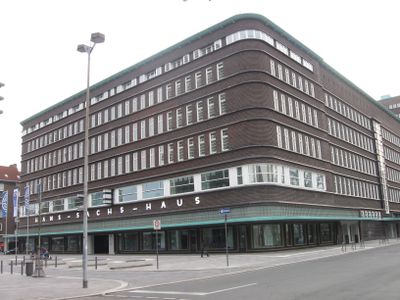
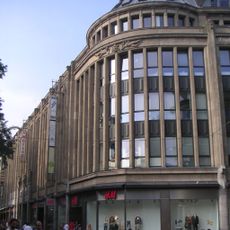
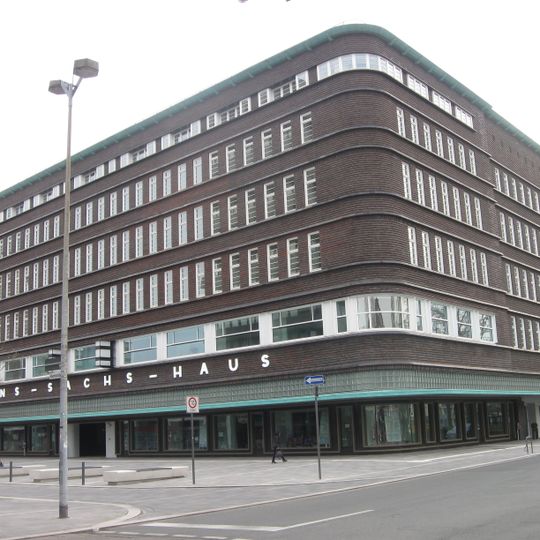
The Hans-Sachs-Haus is a six-story administrative building in Gelsenkirchen with a reinforced concrete frame clad in ceramic panels that define its exterior. Horizontal bands of grouped windows separated by cornices run across the main facades, creating the building's distinctive Art Deco character.
Construction took place between 1924 and 1927 under architect Alfred Fischer's designs, marking an important moment in Gelsenkirchen's modern architectural development. The building suffered damage during World War II and was comprehensively restored from 1947 to 1950.
The building was named through a public competition in 1926, reflecting the connection between labor and craft traditions in the industrial city. This name choice remains visible above the main entrance and continues to define how locals understand the structure.
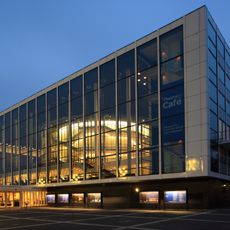
The building now functions as Gelsenkirchen's town hall and houses various municipal departments and a public forum accessible to visitors. The interior features an illuminated atrium that can be explored to get a sense of the building's spatial design.
The building pioneered an innovative color-coded signage system for public spaces, designed by professor Max Burchartz according to Bauhaus principles. This system helped visitors navigate the spaces and traces of it remain visible today.
The community of curious travelers
AroundUs brings together thousands of curated places, local tips, and hidden gems, enriched daily by 91,372 contributors worldwide.