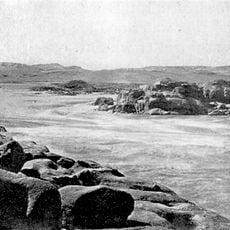
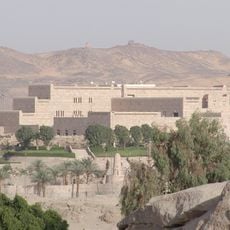
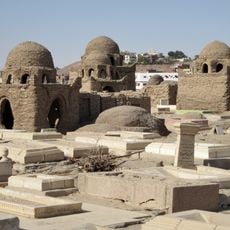
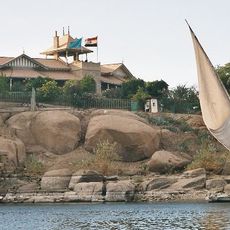
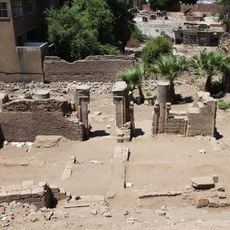
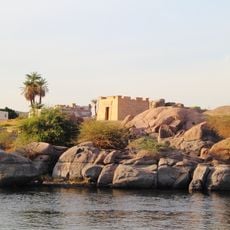
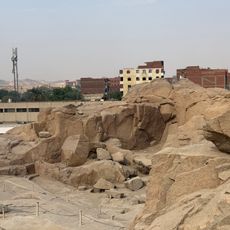
Unfinished obelisk, Ancient granite quarry in Aswan, Egypt
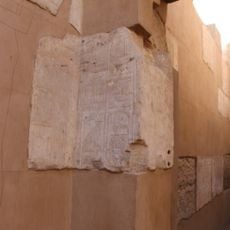
The Unfinished Obelisk is a colossal block of rose granite, about 41.75 metres long, still attached to the bedrock in Aswan's northern quarry. A deep, stepped trench runs along its left side, and a parallel cut lies to its right. Its top surface is flat with shallow hollows and a raised ridge; tool marks and ochre lines remain visible.
A ruler commissioned this obelisk during the 18th Dynasty around 1473 BC to complement another at Karnak Temple. The project was never finished, possibly because workers discovered a flaw in the stone or plans changed.
The unfinished obelisk was possibly ordered by Hatshepsut (1508–1458 BC), perhaps to complement the Lateran Obelisk, originally at Karnak and later moved to Rome. The site is now an open-air museum protected by the Egyptian government, where ochre lines and tool marks remain visible.
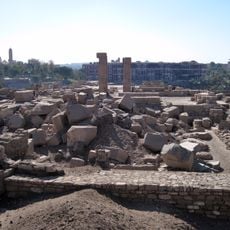
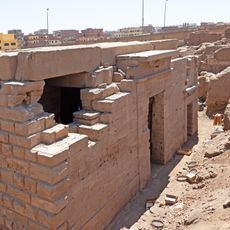
The obelisk lies in the northern part of Aswan's ancient granite quarries, now an open-air museum protected as an archaeological site and part of the UNESCO listing of 1979. The ground around the carved trench is uneven bedrock, so sturdy shoes help; mornings are cooler. The block's lower side is still attached to the rock, and the ochre working lines and tool marks are best seen from the raised edges of the trench.
Workers used dolerite balls harder than granite itself to shape the stone, and they placed water-soaked wooden pegs in cracks that would split the rock as they dried. These methods reveal the ingenuity of ancient construction techniques.
The community of curious travelers
AroundUs brings together thousands of curated places, local tips, and hidden gems, enriched daily by 93,466 contributors worldwide.