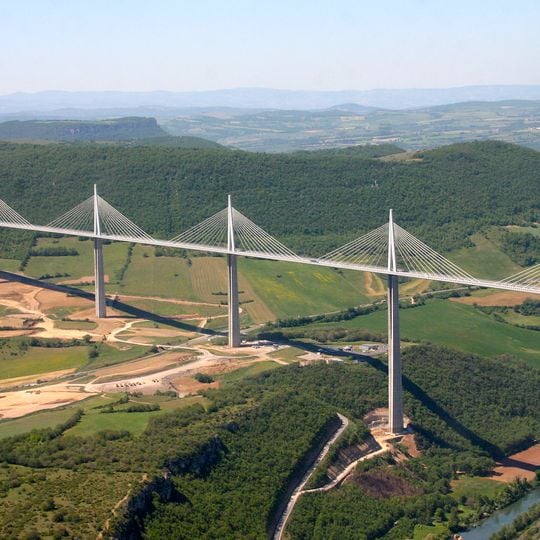
Millau Viaduct

Log in to your account

AroundUs is a community-driven map of interesting places, built by curious explorers like you. It grows with every review, story, and photo you share.
Connect to save your favorite spots, contribute locations, and create personalized routes.
By continuing, you accept our Terms and Conditions and our Privacy Policy
Add to collection
Map
Suggest a change
Share

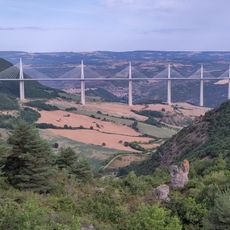
Millau Viaduct, Cable-stayed road bridge in Aveyron, France

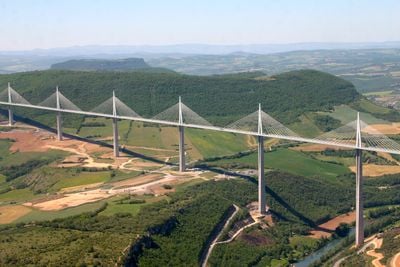
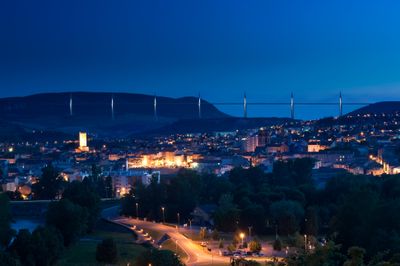
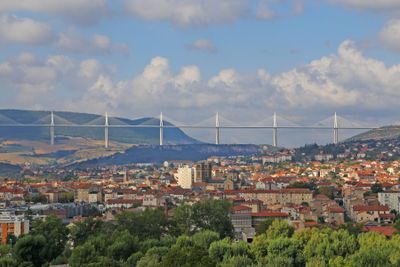
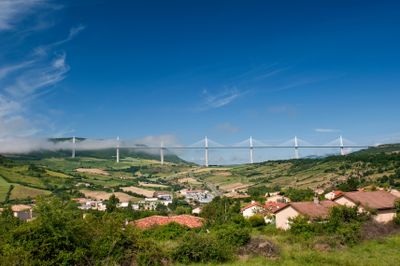
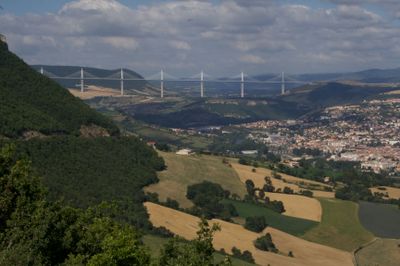
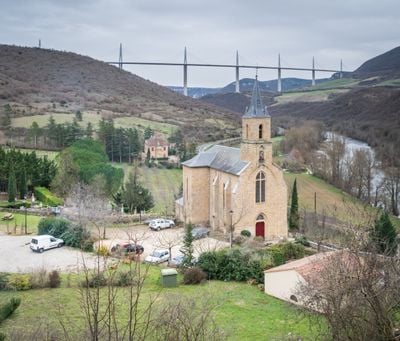
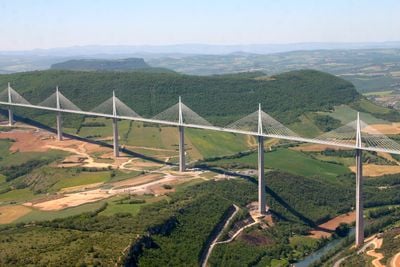
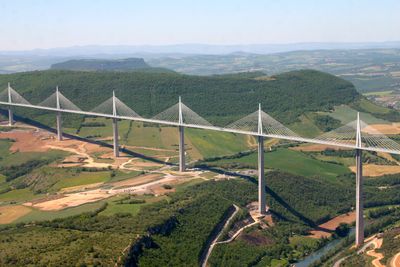
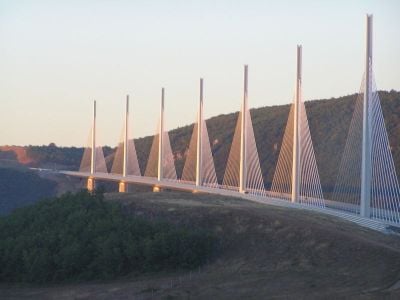
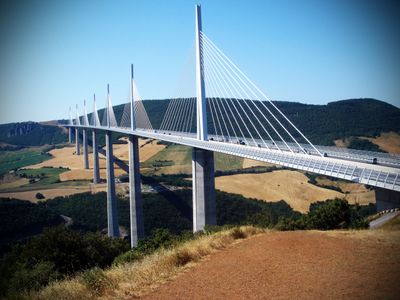
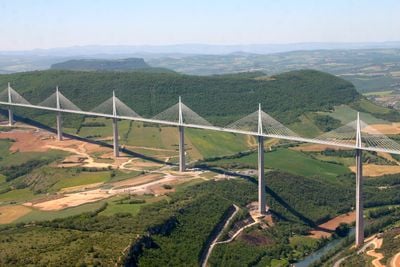
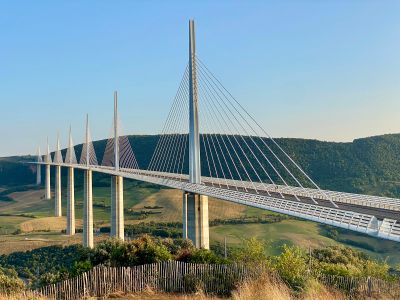
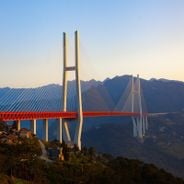
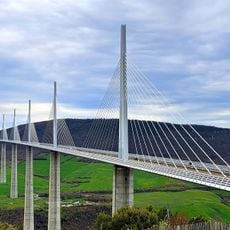
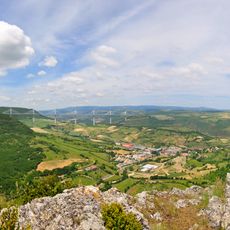
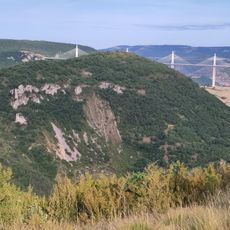
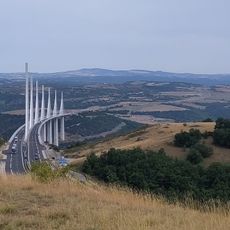
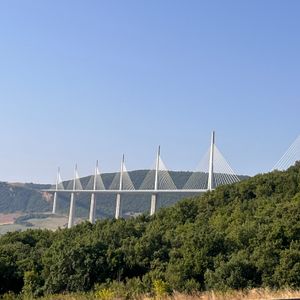
The Millau Viaduct extends across the Tarn River valley with seven concrete pillars supporting a 2,460-meter steel deck at 343 meters above ground level.

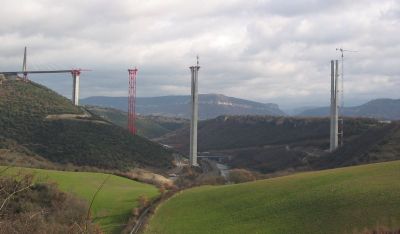
French engineer Michel Virlogeux and British architect Norman Foster collaborated on the bridge design, leading to its construction between 2001 and December 2004.

The viaduct received the Outstanding Structure Award from the International Association for Bridge and Structural Engineering in 2006 for its technical achievement.

Operating as part of the A75 motorway, the bridge reduces travel time between Paris and Mediterranean regions with separate toll fees for different vehicle types.

Engineers installed numerous sensors throughout the structure to monitor movements and structural integrity, ensuring continuous safety assessment of the bridge components.

Location: Millau

Inception: 2001

Architects: Foster and Partners, Norman Foster

Official opening: December 14, 2004

Architectural style: high-tech architecture

Height: 343 m

Length: 2,460 m

Longest Span: 342 m

Width: 12 m

Reference: A 75

Made from material: reinforced concrete

Operator: CEVM

Color: white

Address: Viaduc de Millau, 12400 Millau, France 12400 Millau

Website: https://leviaducdemillau.com/fr

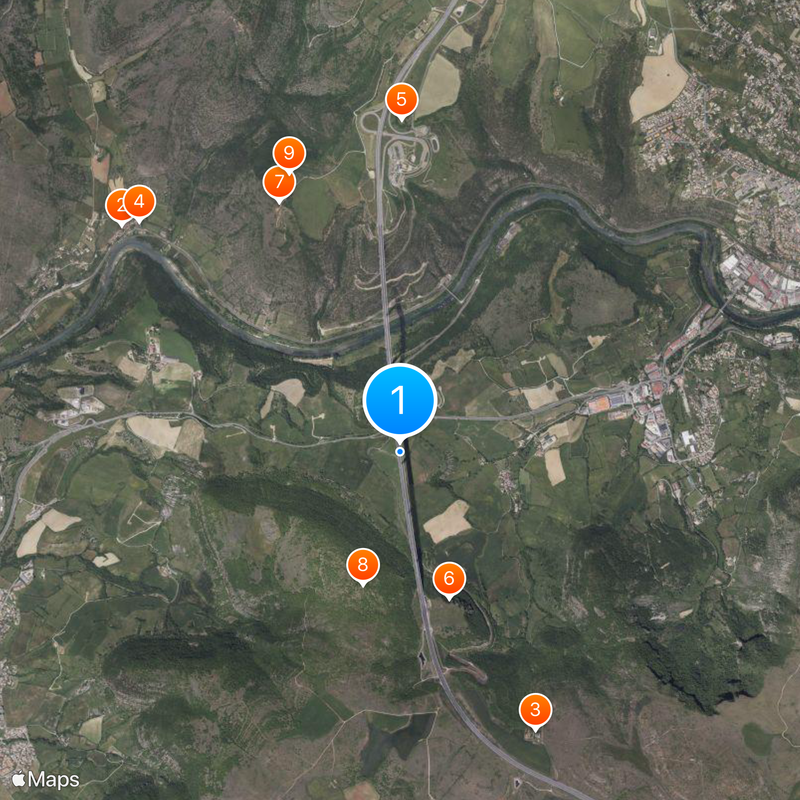
GPS coordinates: 44.07745,3.02284

Latest update: November 20, 2025 21:43

Modern 21st-century architecture: skyscrapers, museums, and landmark buildings

20th and 21st-century architecture has transformed city centers with structures that push engineering boundaries. Observation towers like the Seattle Space Needle and experimental residential complexes like Habitat 67 in Montreal demonstrate the evolution of construction techniques. Architects have explored new forms using materials such as steel, glass, and concrete, creating structures that meet the growing demands of metropolitan areas. This collection includes buildings that marked their time with innovative design. In Barcelona, Antoni Gaudí's Casa Milà features a wavy facade that breaks traditional norms, while in London, 30 St Mary Axe incorporates energy-saving technologies into its 180-meter structure. From Bilbao's Guggenheim Museum clad in titanium to artificial islands shaped in the Persian Gulf in Dubai, these projects illustrate the diversity of architectural approaches worldwide. Each building reflects its urban context while offering solutions to technical and functional challenges of its era.

Major transport structures across the world

This collection brings together some of the most outstanding transport structures worldwide, representing engineering ingenuity and technical daring from various eras. From the Akashi Kaikyō Bridge of Japan, which holds the global record for span length at 1,991 meters (6,532 feet), to the Landwasser Viaduct in Switzerland, built in 1902 and opening directly into a mountain tunnel, each structure tells a story of overcoming geographical challenges. These constructions connect areas separated by bays, straits, deep valleys, or waterways. The Hangzhou Bay Bridge in China stretches 36 kilometers (22 miles) across the waters of the East China Sea, while the Chesapeake Bay Bridge-Tunnel in the United States cleverly combines two modes of crossing over 37 kilometers (23 miles). In Scotland, the Forth Bridge has spanned the estuary since 1890 with its three distinctive steel cantilever spans, and in Bordeaux, the Jacques Chaban-Delmas Bridge stands out as Europe's tallest bascule bridge. Beyond facilitating transport, these structures have become visual landmarks and destinations in their own right. The Royal Gorge Bridge in Colorado overlooks the Arkansas River by 955 feet (291 meters), while London's Millennium Bridge offers a direct pedestrian route between the Tate Modern and Saint Paul’s Cathedral. Each of these sites warrants a visit to appreciate the scope of technical achievement they embody.

Remarkable bridges around the world

This collection gathers bridges and engineering structures that mark the history of modern infrastructure worldwide. Structures such as the Akashi-Kaikyo Bridge in Japan, with its span of 3,911 meters, or the 37-kilometer Chesapeake Bay Bridge-Tunnel in Virginia demonstrate technological advances made to cross natural obstacles. These include suspension bridges, cable-stayed bridges, and viaducts that often set records for length or height. From the Confederation Bridge linking Prince Edward Island to New Brunswick in extreme weather conditions, to the Øresund Bridge connecting Denmark and Sweden, these structures change the geography and facilitate exchanges between regions. The Vasco da Gama Bridge in Lisbon, the Norman Bridge crossing the Seine at Honfleur, or the Yavuz Sultan Selim Bridge in Istanbul illustrate how modern engineering addresses transportation needs while adapting to each site's geographic constraints.

Historical buildings in France: castles, cathedrals, Roman architecture

France's historical architecture documents two millennia of construction, from Roman amphitheaters to modern bridge engineering. The structures demonstrate developments in engineering and architecture across multiple periods. The heritage extends from medieval fortifications like Carcassonne and the Fortress of Salses through Gothic cathedrals such as Notre-Dame de Paris and Amiens Cathedral to Renaissance châteaux including Chambord and Chenonceau. Roman engineering persists in the Pont du Gard and the Arena of Nîmes, while the Papal Palace in Avignon and Sainte-Chapelle illustrate medieval political and religious authority. The Loire Valley châteaux and fortified structures like Bonaguil and Pierrefonds demonstrate defensive architecture and aristocratic living. The 20th century brought new perspectives with Le Corbusier's Villa Savoye, a defining work of modern architecture. The Millau Viaduct represents contemporary engineering achievement. Pilgrimage sites like the Basilica of Sainte-Anne-d'Auray and Mont Saint Michel Abbey combine religious significance with architectural skill. These structures provide insight into French history, construction traditions and technical innovation through the centuries.

The most impressive bridges in the world

Bridges are a part of our daily lives. They have connected banks, valleys, and communities for centuries. This collection presents structures from various periods and regions. From medieval stone arches to modern steel constructions, these works demonstrate the evolution of engineering. The Rialto Bridge from the 16th century in Venice spans the Grand Canal with a single stone arch. The Golden Gate in San Francisco stretches over 1.7 miles (2.7 km), linking the city to northern California. In Singapore, the Helix Bridge forms a pedestrian link in Marina Bay with its double-helix structure. These structures serve practical purposes in urban transportation while shaping city skylines. They provide technical solutions to geographical barriers and reflect different approaches to bridge construction through the ages.

The most impressive constructions in the world

This collection brings together some of the most technically ambitious structures ever built, from record-breaking skyscrapers and suspension bridges to high-speed roller coasters that push the boundaries of what steel and concrete can achieve. These sites span continents and represent decades of engineering progress, offering visitors a chance to experience human innovation at heights and speeds that were once impossible. Whether you're standing on the observation deck of the Burj Khalifa in Dubai, walking across the glass floor panels of the CN Tower in Toronto, or racing through the launch sequence of Kingda Ka in New Jersey, each structure tells a story of technical ambition and problem-solving. The collection includes landmarks like the 324-meter Eiffel Tower in Paris, completed for the 1889 World Exhibition, and modern marvels such as Tokyo Skytree, which rises 634 meters above the city. You'll find the Millau Viaduct spanning the Tarn River valley in France at a height of 336 meters (1,100 feet), the tilted medieval bell tower in Pisa leaning at a 3.97-degree angle, and Russia's SkyBridge suspended between mountain peaks at 2,320 meters (7,600 feet) elevation. These places attract millions of visitors each year, offering not just views and thrills but a firsthand understanding of what modern engineering can accomplish when designers set out to build something exceptional.

Industrial constructions: global technical and architectural innovations

This collection brings together major technical achievements that have marked the history of modern engineering. From the Hoover Dam on the Colorado, built in 1936 to produce hydroelectric power, to the ITER nuclear fusion project in France, which represents the future of energy research, these structures exemplify human boldness and skill. Each structure serves a specific purpose: crossing natural obstacles like the Brooklyn Bridge, connecting Manhattan to Brooklyn since 1883, facilitating maritime trade with the Panama Canal between the Atlantic and Pacific, or pushing height limits with the Burj Khalifa at 828 meters. These achievements are visited around the world and often offer remarkable experiences. The Eiffel Tower welcomes 7 million visitors each year who ascend to discover Paris from its 324-meter height. Shanghai's Maglev allows travel at 430 kilometers per hour thanks to magnetic levitation. The Millau Viaduct crosses the Tarn Valley at 343 meters above sea level over 2,460 meters in length. These engineering landmarks invite understanding of how industrial architecture has shaped our modern world, combining functional necessity with technical prowess that continues to fascinate visitors worldwide.

Notable suspension bridges worldwide

This collection presents suspension bridges recognized for their engineering solutions and their role in urban development. The Akashi Kaikyō Bridge in Japan spans 1,991 meters between its two towers, the longest distance of its kind in the world. The Golden Gate Bridge in San Francisco demonstrates 1930s engineering with its 1,280-meter main span. In New York, the Brooklyn Bridge has connected Manhattan to Brooklyn since 1883 and serves as an early reference point in modern bridge construction. The Humber Bridge in England held the record for the longest span from 1981 to 1998. In Istanbul, the Bosphorus Bridge has linked Europe to Asia since 1973 across a span of 1,074 meters. The Tower Bridge in London has combined a bascule bridge with suspension elements since 1894. These structures document the evolution of construction techniques over more than a century and remain important transportation routes in their respective regions.

Motorcycle routes in France: Alpine passes, coastal roads, and historic circuits

France offers motorcyclists a diverse landscape, from Alpine peaks to Mediterranean coasts, including wine regions. The country is suitable for all riding styles, with demanding mountain roads, winding coastal routes, and rural paths. Key routes include the Col de la Bonette, reaching 2802 meters and connecting Ubaye to Tinée over 26 kilometers. The Gorges du Verdon feature 21 kilometers of rock-carved road, passing through tunnels and 700-meter-high cliffs. The Routes of the Great Alps cross 16 passes over 684 kilometers between Lake Geneva and the Mediterranean, with a total ascent of 15,700 meters. Mount Ventoux, accessible via three routes and standing at 1912 meters, passes through lavender fields and vineyards in Provence. Regions display striking contrasts: Corsica alternates between cliff roads and pine forests, the French Riviera combines coast and mountainous hinterland, and Dordogne winds between limestone cliffs and medieval villages. Lake Annecy connects water bodies with forested mountain passes. These routes feature technical curves, varied landscapes, and cultural sites.

Reviews

Real people, real opinions — but not verified.

Visited this place? Tap the stars to rate it and share your experience / photos with the community! Try now! You can cancel it anytime.

timo2010
@timo2010

Apr 16, 2025 18:44

This bridge overlooks an extraordinary area; don't hesitate to pass through the town of Millau on a market day!

stephren
@stephren

Mar 29, 2025 06:56

A real technical feat in an exceptional setting

« Millau Viaduct - Cable-stayed road bridge in Aveyron, France » is provided by Around Us (aroundus.com). Images and texts are derived from Wikimedia project under a Creative Commons license. You are allowed to copy, distribute, and modify copies of this page, under the conditions set by the license, as long as this note is clearly visible.

Discover hidden gems everywhere you go!

From secret cafés to breathtaking viewpoints, skip the crowded tourist spots and find places that match your style. Our app makes it easy with voice search, smart filtering, route optimization, and insider tips from travelers worldwide. Download now for the complete mobile experience.


Around Us App Screenshot

A unique approach to discovering new places

Le Figaro

All the places worth exploring

France Info

A tailor-made excursion in just a few clicks

20 Minutes