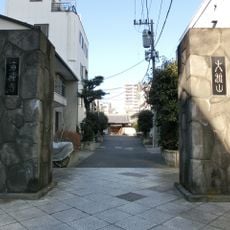
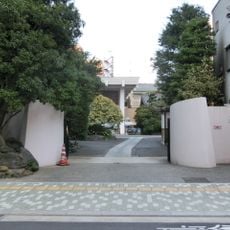
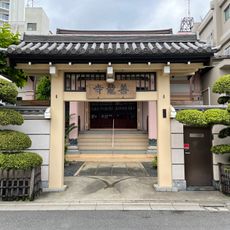
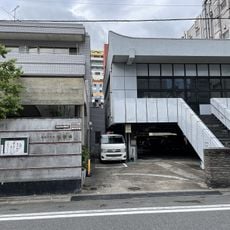
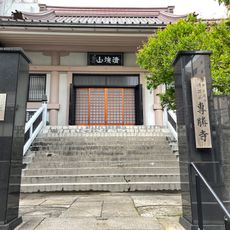
日輪寺, Ji-shū Buddhist temple in Asakusa, Taitō-ku, Japan.
Nichirin-ji is a Jishū (Pure Land) Buddhist temple in Asakusa 3-chōme, Taitō-ku, with the mountain name Kanda-san and Amida Nyorai as its principal image. The site was originally a Tendai temple in Shibasaki Village, now Chiyoda; it became a Jishū nenbutsu dōjō after the monk Taa Shinkyō repaired and memorialized the burial mound of Taira no Masakado during the Tokuji era (1303–1308).
Originally a Tendai temple in Shibasaki village (now Chiyoda), it became a Jishū temple after the monk Taa Shinkyō visited during the Tokuji era (1303–1308). He repaired and memorialised a mound feared to be the cursed grave of Taira no Masakado, the epidemic subsided, and villagers urged the temple's conversion into a nenbutsu hall. It burned in the 1657 Meireki fire and moved to Asakusa, where it served as a Jishū supervisory temple and the Hotta family's burial temple.
The neighbourhood name Asakusa-Shibasaki-chō comes from the temple's former name, Shibasaki-dōjō. The temple belongs to the Jishū school and honours Amida Buddha as its main image; it served as a Jishū supervisory temple (furegashira) in the Edo period and was the family temple of the Hotta clan.
The temple stands in Asakusa 3-chome, Taitō-ku, about two minutes on foot from exit A2 of Asakusa Station on the Tsukuba Express. The grounds lie in the old Asakusa Shibasaki-chō quarter, named after the temple's former name, Shibasaki dōjō.
The neighbourhood name Asakusa-Shibasaki-machi came from the temple itself: it was called Shibasaki-dōjō, the Shibasaki practice hall. The temple also served as the head temple (furegashira) of the Jishū school in the Edo period and was the family temple of the Hotta clan.
The community of curious travelers
AroundUs brings together thousands of curated places, local tips, and hidden gems, enriched daily by 93,486 contributors worldwide.