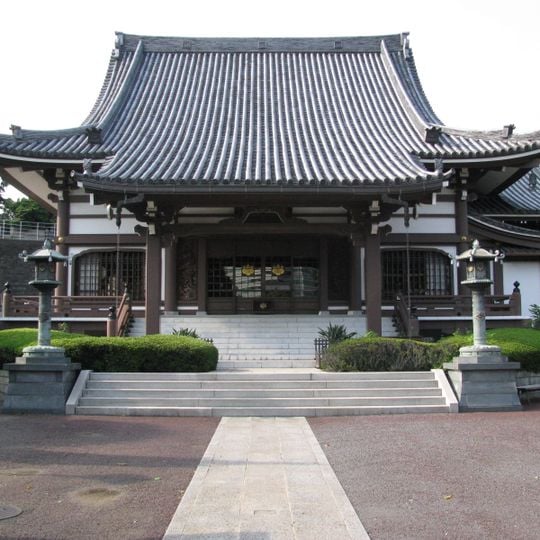
Hongaku-ji Temple, Buddhist temple in Kanagawa-ku, Japan.
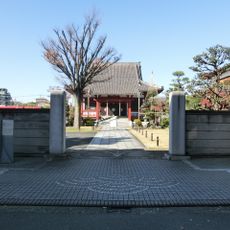
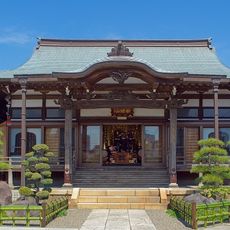
Hongaku-ji is a Soto Zen temple on a hill in Takashimadai, near Kanagawa Station. Its main hall is dark brown wood with white plaster panels between the posts, under a grey hipped-and-gabled tiled roof with deep eaves. About six stone steps lead up to a wide platform, where four black metal lanterns stand on stone bases, two on each side, and dark doorways and grilles sit between the pillars.
Tradition holds that the temple was founded in 1226 by Eisai, the founder of Rinzai Zen, on a hill overlooking the Tokaido and the port of Kanagawa. It was laid waste in 1510 during the Gongenyama battle between the Uesugi clan and Ueda Masamori, then revived in 1532 as a Soto Zen temple. In 1859 the first American consulate in Yokohama opened here, and in 1862 the wounded of the Namamugi Incident were treated on the grounds.
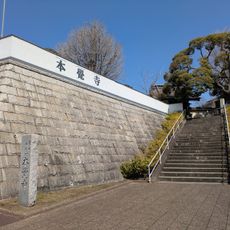
The temple's white-painted main gate survived both the 1923 earthquake and wartime bombing and still stands. In 1859 the first American consulate in Yokohama was set up here because the harbour could be seen from the hill; in 1862 the wounded Woodthorpe Clarke and William Marshall were brought here for treatment after the Namamugi Incident.
Hongaku-ji sits on a hill beside Kanagawa Station on the Keikyu Main Line and the Aoki Bridge crossing of National Route 1 (Dai-ni Keihin). The grounds were cut back for the railway and later for the Dai-ni Keihin road, so the approach is short but slopes; the stone stairway of about six steps leads up to the main hall platform.
The temple's white-painted main gate survived both the 1923 earthquake and wartime bombing. It was painted white with oil paint when the American consulate opened here in 1859, and it still stands near the Aokibashi crossing today.
The community of curious travelers
AroundUs brings together thousands of curated places, local tips, and hidden gems, enriched daily by 93,481 contributors worldwide.