Ikeda Castle, Medieval castle in Ikeda, Japan
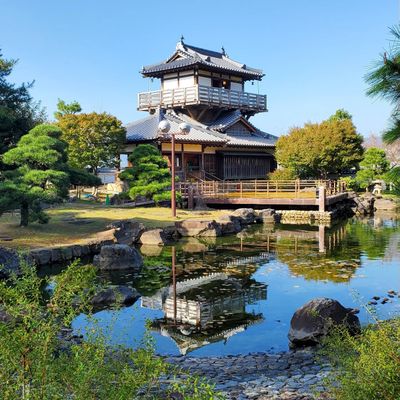
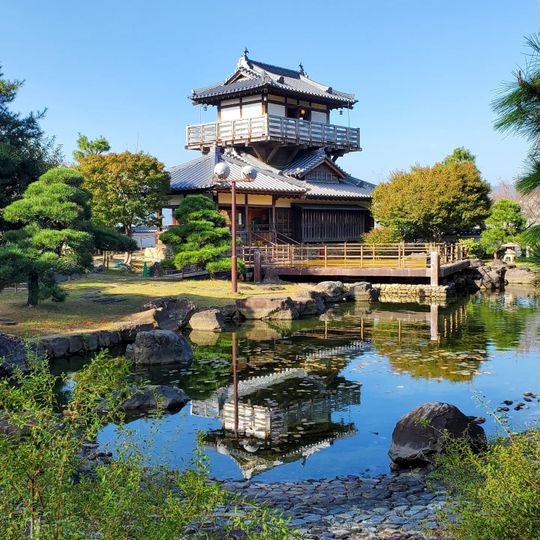
Ikeda Castle occupied a ridge on the southern slope of Mount Satsuki, using a western cliff and the Sugigatani River to the north for defence. Its east and south sides were protected by a moat up to 25.7 m wide and 6.5 m deep, plus earthen ramparts. The site is now Ikeda Castle Ruins Park, with reconstructed wooden structures and a garden.
Ikeda Noriyori built the castle around 1334 on a ridge at the southern foot of Mount Satsuki. It fell in 1469 to Ōuchi Masahiro's army, and in 1508 to Hosokawa Takakuni, after which Ikeda Sadamasa killed himself. Oda Nobunaga took it in 1568 and kept Ikeda Katsumasa as lord, granting him 60,000 koku. Araki Murashige seized it around 1570, and Nobunaga ordered it abandoned in 1580.
The name Ikeda comes from the Ikeda clan, who held the castle from its founding around 1334 until the Sengoku period. Excavations from 1989 uncovered a dry-landscape garden inside the main enclosure, showing that the castle was also a residence. Today the site is Ikeda Shiroato Park, completed in 1999, with a reconstructed yagura watchtower, Japanese gardens, wooden bridges and a tea room.
The site is a 15-minute walk from Ikeda Station on the Hankyu Takarazuka Line. The park was completed in 1999, and the excavated remains were restored as part of its layout, so the moat and earthen-wall lines can be traced on the ground.
The main enclosure held a dry-landscape garden, showing that the castle was a residence as well as a defensive site. Excavations from 1989 to 1993 uncovered remains that were later restored in the park, and the moat reached 25.7 m wide and 6.5 m deep.
The community of curious travelers
AroundUs brings together thousands of curated places, local tips, and hidden gems, enriched daily by 93,651 contributors worldwide.