Seiken-ji Temple, Buddhist temple in Shimizu-ku, Japan
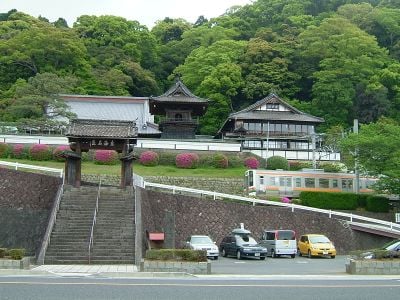
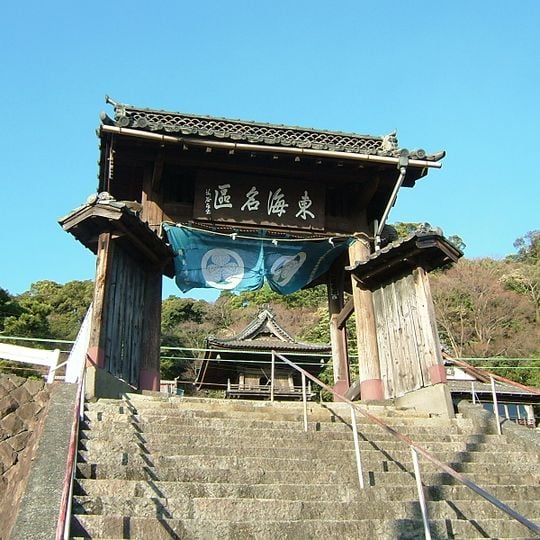
Seiken-ji is a Rinzai Zen temple on a hill above Suruga Bay in Okitsu, Shimizu-ku, Shizuoka. Its wooden sanmon gate, built in 1651, stands at the top of a stone staircase; the plaque reads 東海名區. Behind it rise a two-story hall with a tiered tiled roof and a long building with an upper row of windows, all set on a stone retaining wall above a parking area.
Founded in the Hakuchi era (650–654) as a Tendai temple guarding the Kiyomi-seki checkpoint on the Tōkaidō, Seiken-ji was revived as a Rinzai Zen temple by the monk Enni in 1262. It was named a Jissetsu temple in 1343 and later prospered under the patronage of Imagawa Yoshimoto and Tokugawa Ieyasu, who as a young hostage was tutored here by abbot Sessai Chōrō.
Seiken-ji served as a lodging for Joseon missions to Japan and Ryukyu Kingdom delegations traveling the Tōkaidō; a Joseon envoy stayed in 1607 and another in 1655. In 1610 the Ryukyu prince Gushichan Chōsei died at Sunpu on his way to Edo and was buried here. The temple's Joseon-mission sites are a National Historic Site, and its garden a National Place of Scenic Beauty.
The temple stands on a hill above Okitsu, about 15 minutes on foot from JR Okitsu Station on the Tōkaidō Main Line, or one minute from the Kiyomidera bus stop. The Tōkaidō Main Line tracks cut across the temple grounds, so the approach passes under or beside the railway. Stone steps with metal handrails lead up to the gate.
The garyū-bai plum tree in the grounds is said to have been planted by hand by Matsudaira Takechiyo, the boy later known as Tokugawa Ieyasu, while he was tutored at the temple by abbot Sessai Chōrō around 1549. Its name, "recumbent dragon plum", refers to the low, sprawling shape of its trunk and branches.
The community of curious travelers
AroundUs brings together thousands of curated places, local tips, and hidden gems, enriched daily by 94,328 contributors worldwide.