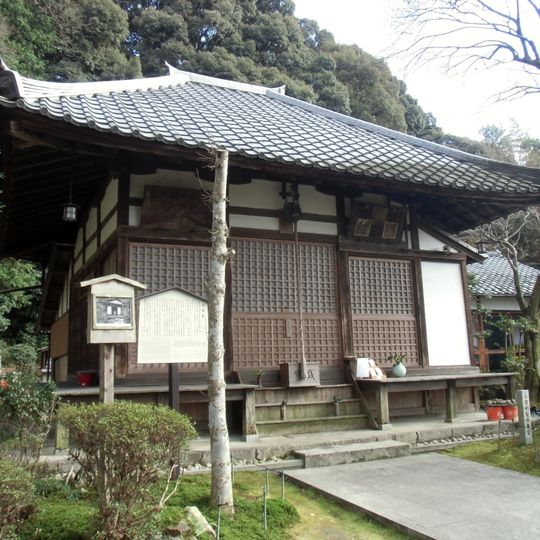
Seikan-ji Temple, Buddhist temple in Higashiyama-ku, Japan
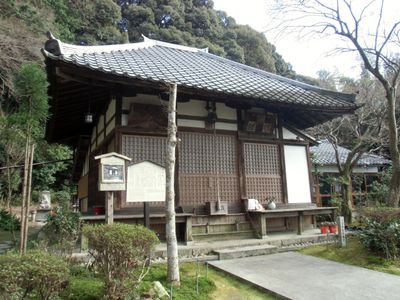
Seikan-ji is a single-story wooden temple in a valley on the slope of Mount Kiyomizu in Higashiyama-ku. Its dark grey tiled roof curves upward at the eaves; the facade has a broad latticed panel and a gridded window, with a raised veranda and a large wooden bell hung by ropes in the left bay. Two wooden signboards stand in front.
Founded in 802 by the monk Shōkei of Mount Hiei, the temple was revived in the 10th century by Saeki no Kin'yuki as a Shingon chapel. In 1176 Emperor Rokujō was buried here, followed in 1181 by Emperor Takakura, whose tomb lies in the precinct. The temple was destroyed in 1468 during the Ōnin War and rebuilt in the Keichō era (1596–1615).
The temple honors an eleven-faced thousand-armed Avalokiteshvara, a key bodhisattva in Shingon Buddhism that pilgrims come to venerate. This focus shapes how visitors experience and interact with the space today.
The temple sits about a 10-minute walk from Keihan Bus Seikanji Yananouti-cho stop. Early morning visits are recommended, as the trail is less crowded and natural light is better for exploring the narrow valley setting.
The Kanameishi is a boulder partly exposed in the temple forecourt, named because it sits at the pivot point of a fan: from here the city of Kyoto opens out below like the spread ribs of a folding fan. It is now fenced by a low tamagaki with paper streamers at the four corners, and worshippers come to make vows there, which are said to be granted.
The community of curious travelers
AroundUs brings together thousands of curated places, local tips, and hidden gems, enriched daily by 93,460 contributors worldwide.