Enkō Bridge, Road bridge in Minami-ku, Hiroshima, Japan
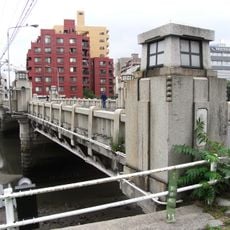
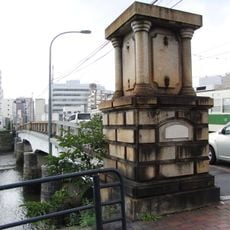
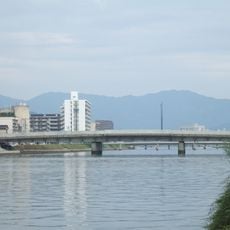
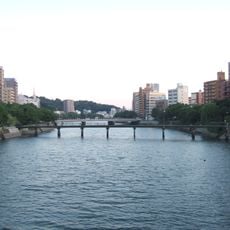
Enkō Bridge is a reinforced-concrete T-beam road bridge over the Enkō River, 62.4 m long and 8.5 m wide, completed in 1926. Its granite newel posts, balusters and railings carry Secession-style metal ornaments: eagles with spread wings on globes atop the four corner posts and pairs of monkeys holding a peach on the railings. The ornaments were removed in 1943 and restored in 2016.
A first bridge, then called Enrō, was built here around 1589, when Hiroshima Castle and its castle town were laid out. It carried the Saigoku Kaidō and later National Route 4, and in 1894 Emperor Meiji crossed it from Hiroshima Station to the Imperial Headquarters. The present reinforced-concrete girder bridge was completed in March 1926 by the Tsumaki company; it withstood the 1945 atomic blast about 1.82 km from the hypocenter and served as an evacuation route.
The bridge takes its name from the Enkō River, and enkō is an old word for the kappa, a water spirit. The left-bank district of Enkōbashi-machi is named after the bridge. The 2016 restoration recreated the 1926 metal ornaments: eagle figures on globes atop the four corner pillars and two monkeys holding a peach on the railings.
The bridge is located roughly 2 kilometers from the atomic bomb hypocenter and is easily accessible on foot. The surrounding area is pedestrian-friendly and well integrated into the city's sightseeing routes.
The bridge was originally built with elaborate decorations including eagle statues mounted on spheres and engraved monkey motifs, making it the most ornamental crossing of its kind in Hiroshima. These artistic details give visitors insight into how Japanese bridge architects designed public works during the 1920s.
The community of curious travelers
AroundUs brings together thousands of curated places, local tips, and hidden gems, enriched daily by 94,261 contributors worldwide.