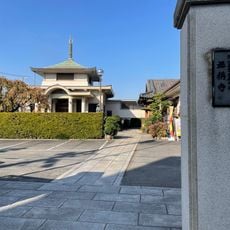
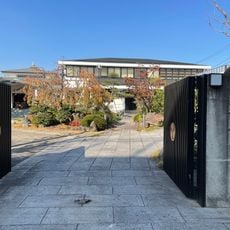
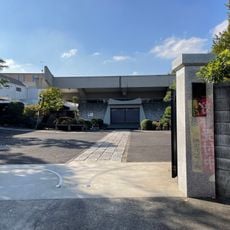
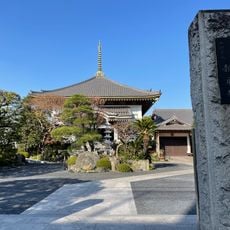
Seiseki Kamata Umeyashiki Park, Urban park in Kamata, Japan.
Seiseki Kamata Umeyashiki Park is a Japanese-style garden in Kamata, Ota ward, Tokyo, planted with many plum trees. A pond lies at its centre, with a walking path running around it. The grounds are a remnant of the plum garden opened by the medicine seller Yamamoto Kyūzaburō during the Bunsei era.
The site began in the Bunsei era (1818–1830) when the pharmacist Yamamoto Kyūzaburō planted plums and opened a teahouse. Emperor Meiji visited nine times between 1868 and 1897 and planted a plum himself on 6 March 1873. After becoming a Keihin Electric Railway lot in 1920, it was saved by the Meiji Emperor Sacred Site Preservation Society, donated to Tokyo City in 1938, and opened as a park on 12 October 1939.
The name Umeyashiki comes from the plum garden opened in the Bunsei era by the Kusaburo Yamamoto family, who ran a medicine shop and planted old plum trees bought from nearby orchards. The garden's fame was such that in the Bunsei era it rivalled Kameido's Garyobai. Visitors can still see plum trees, and the park is known for the Senjobai, the plum planted by Emperor Meiji in 1873.
The park lies along the Keikyu line, a 7-minute walk from Umeyashiki Station and 8 minutes from Keikyu Kamata Station. A pond with a walking path around it forms the centre of the grounds. Part of the site has been used as a works yard for the Keikyu Kamata grade-separation project and is to be restored when work ends; a planned widening of Route 15 covers about half the park.
The plum trees here bloom in winter, weeks before cherry trees flower across the city, which many visitors do not expect. Coming in February means finding white and pink blossoms at a time when most other parks in Tokyo are still bare.
The community of curious travelers
AroundUs brings together thousands of curated places, local tips, and hidden gems, enriched daily by 94,777 contributors worldwide.