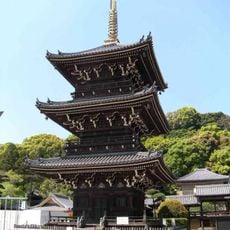
蟻通神社, Shinto shrine in Japan
Aritoshi Shrine in Izumisano is a Shinto shrine whose main hall, rebuilt in 1669 by Kishiwada lord Okabe Nobukatsu, was moved to its present site in 1944 for the Sano army airfield. The grounds hold a dance hall, a drum bridge, and a pond called Kanmuri-no-fuchi, named after Ki no Tsurayuki's cap falling in.
According to shrine tradition, it was founded in 93 CE under Emperor Kaika to pray for grain harvests and land development. It was burned in 1577 during Oda Nobunaga's attack on Saika and again in 1615 during the Battle of Kashii. Toyotomi Hideyori rebuilt the main hall in 1603, and in 1944 the shrine was moved to its present site for the Sano Army Airfield.
The name Aritōshi comes from a tale in Sei Shōnagon's Pillow Book, where an ant was threaded through a seven-curved jewel. Ki no Tsurayuki's poem to the deity, written after his horse fell ill, is still linked to the shrine. Every September, local volunteers hold the Aritohoshi Takigi Noh, and the Noh play Aritōshi has been performed there.
The shrine is a 15-minute walk from JR West Hanwa Line's Nagataki Station, or a community bus ride to the Aritoshi-jinja-mae stop. The grounds were rearranged when the shrine was moved here in 1942-1944, so the main hall, worship hall, dance hall and gates sit close together. The Kanno-fuchi pond, named for Ki no Tsurayuki's fallen cap, was rebuilt in its original form in 1942.
The Noh play Aritō, written by Zeami, dramatizes Ki no Tsurayuki's poem to the shrine deity after his horse collapsed in the shrine grounds. Since 2014 the shrine has held the annual Aritohoshi Takigi Noh on its dance hall stage in September; the first and fifth editions (2019) performed Aritō.
The community of curious travelers
AroundUs brings together thousands of curated places, local tips, and hidden gems, enriched daily by 94,799 contributors worldwide.