Tanjō-ji Temple, Buddhist temple in Kumenan, Japan.
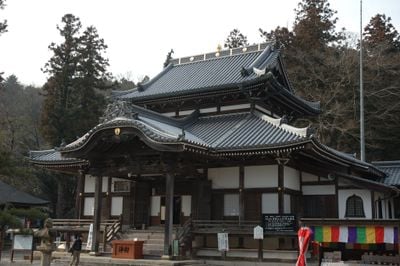
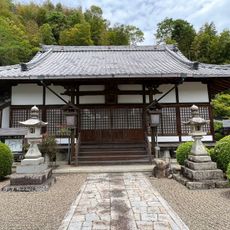
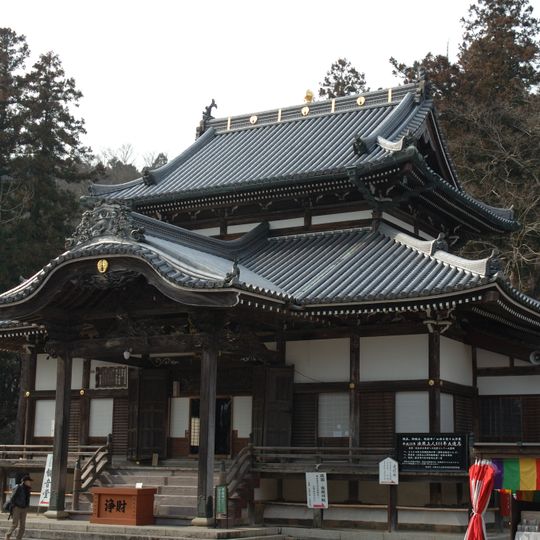
Tanjō-ji is a Jōdo-shu temple on the birthplace of the monk Hōnen, founded in 1193 by Kumagai Naozane. Its main hall, the Goeidō, rebuilt in 1695, has a multi-tiered dark grey tiled roof with golden finials and a curved gable, white plaster panels between dark timber framing, and stone steps up to a porch of thick pillars. A dark signboard with white Japanese text hangs at the right.
The temple was founded in 1193 by Kumagai Naozane and is connected to the birth of the monk Honen, who later established the Jodo-shu branch of Pure Land Buddhism in Japan. This connection made it a center for spreading these teachings throughout the country.
The temple's annual rite, held on the third Sunday of April, is formally called the Honen Shonin Goryoshin Gotsuion Nijugo Bosatsu Tendo Geigō Renkuyō Koshiki Daihōyō. Said to date from the Muromachi period, it is counted among Japan's three great renkuyō, processions in which twenty-five bodhisattvas come to welcome the dying. The temple was long known as Tanjō Risshō-ji, and the plaque on the Miei Hall still reads "Tanjō Risshō-ji".
From JR Tanjō-ji Station the temple is a 10-minute walk. By car it is about 20 minutes southeast of the Innoshō Interchange on the Chūgoku Expressway, or about 30 minutes southwest of the Tsuyama Interchange.
The temple's Great Buddha, cast in 1745, is the largest Buddhist statue in Okayama Prefecture: 6.42 m tall and weighing 450 kg. It is a designated prefectural important cultural property, and visitors often walk past it on the way to the main hall.
The community of curious travelers
AroundUs brings together thousands of curated places, local tips, and hidden gems, enriched daily by 93,509 contributors worldwide.