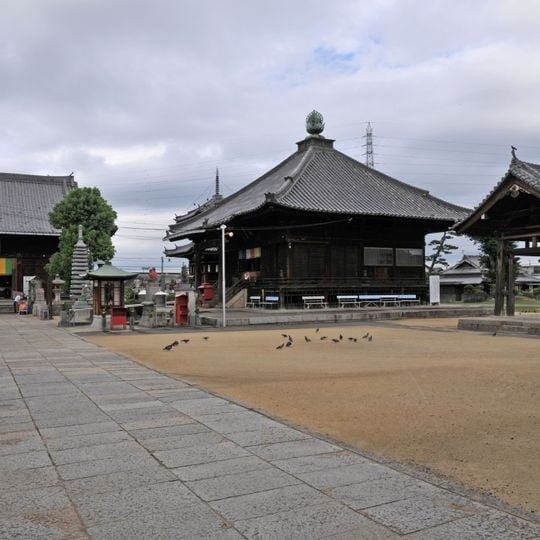
Dōryū-ji Temple, Buddhist temple in Tadotsu, Japan.
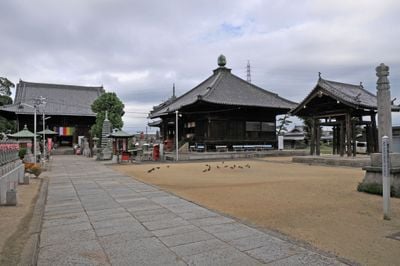
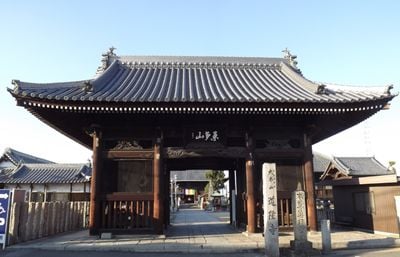
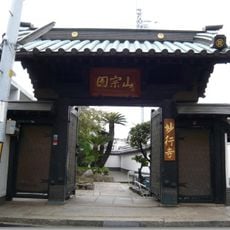
Dōryū-ji is a Shingon temple in Tadotsu whose grounds are entered through a Niō gate with a broad tiled roof and a plaque above the central opening. Inside, the main hall stands at the end of the approach, with a dark hip-and-gable roof, a metal finial at the ridge, and a low stone platform with short steps. A small open gate with its own tiled roof stands to the right.
According to temple tradition, the local lord Wake no Dōryū founded the temple after carving a Yakushi Nyorai from a mulberry tree. In 807 his son Tomosuke asked Kūkai to make a 90 cm Yakushi statue, placed his father's image inside it, and built the seven-hall complex. Shinga, Enchin and Shōbō led the temple in turn, but earthquakes in 976–978 and fires in 1060 and the Tenshō era destroyed buildings repeatedly.
Dōryū-ji belongs to the Shingon Daigo school, not the Kegon school. Its name comes from the local lord Wake no Dōryū, whose son Tomosuke had Kūkai carve a 90 cm Yakushi Nyorai in 807. The temple is the 77th stop on the Shikoku 88-temple pilgrimage, and its gōeika verse plays on the characters for Dōryū.
The temple is accessible from Tadotsu station via local transport connections, with ample parking available for visitors arriving by car. Clear signage throughout the area helps guide you to the main entrance and temple grounds.
The temple keeps a silk Star Mandala (Hoshi Mandara), a painting of the star deities, registered as an Important Cultural Property of Japan on 27 March 1901. The temple also holds a Lotus Sutra Mandala from the Nanboku-chō period, used as the main image at the Hokke-e ceremony, and a red Fudō Myōō portrait from the Muromachi period.
The community of curious travelers
AroundUs brings together thousands of curated places, local tips, and hidden gems, enriched daily by 93,558 contributors worldwide.