Akiru Shrine, Shinto shrine in Tokyo, Japan
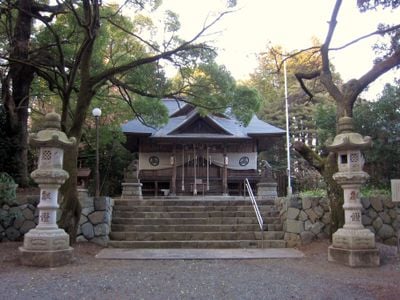
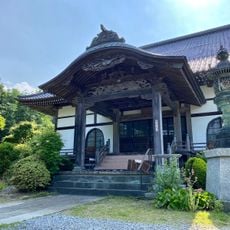
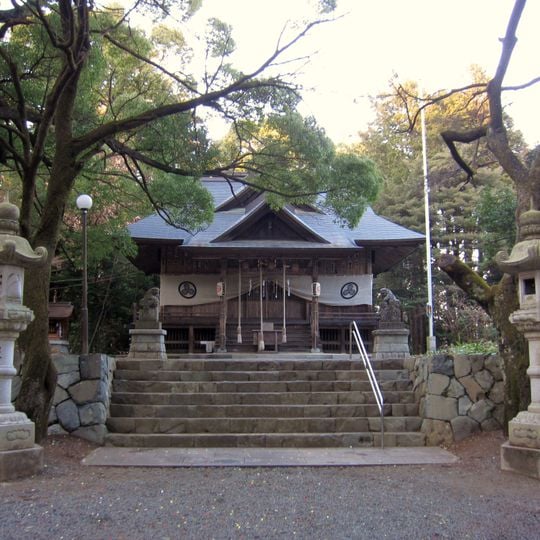
Akiru Shrine stands on a terrace above the Akikawa, reached by a stone stairway of about ten steps. The dark timber hall has a central bay of wooden lattice panels, a hanging bell rope, and a white cloth banner with two dark crests beneath the eaves. Two stone guardian figures flank the top of the stairs, and a white rope hangs across the entry.
The shrine appears in the Engishiki register of 927 as the first of eight Tama District shrines in Musashi Province. In 884 the court raised the rank of Sakikiri Shrine to Junior Fourth Rank, Lower Grade. In 940 Fujiwara no Hidesato invited the Kasuga deity here, and the shrine was later called Kasuga Daimyojin or Matsubara Daimyojin. The present hall dates from 1888, after the 1830 Goitsuka fire.
The shrine's four enshrined deities are Ōmononushi, Ajisukitakahikone, Takehinadori and Amenokoyane, not Amaterasu. From the Middle Ages it was called Kasuga Daimyōjin after Fujiwara no Hidesato invited the Ōharano deity here in 940, and locally Matsubara-sama. The September 28–30 Grand Festival, the Gojūsai, opens with a hexagonal mikoshi of about 600 kg made in the Tenpō era.
The shrine stands at 1081 Itsukaichi, Akiruno, about 15 minutes on foot from Musashi-Itsukaichi Station on the JR Itsukaichi Line. The approach climbs a stone stairway of roughly ten steps, with a metal handrail on the right; two stone guardian figures stand at the top. At the Haraedo sub-shrine inside the grounds, visitors purify themselves with the hemp wands provided, shaking them left, right and left.
The shrine's name, also written 畔切 and read akiru, means "ridge-cutting", pointing to the clearing of the Akikawa terrace where the shrine stands above rice fields. A theory holds that the shrine was founded when the area was first opened for cultivation.
The community of curious travelers
AroundUs brings together thousands of curated places, local tips, and hidden gems, enriched daily by 93,628 contributors worldwide.