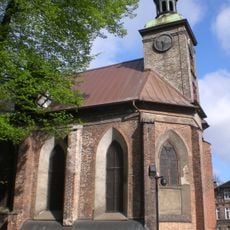
Garnizonowy Cemetery in Gdańsk, Military cemetery in Gdańsk, Poland
The Garnizonowy Cemetery is a 2.19-hectare municipal cemetery at ul. gen. Henryka Dąbrowskiego 2 in the Aniołki district of Gdańsk. It contains a neo-Gothic wooden funeral chapel built in 1896 and renovated in 1990–1992, a neo-Gothic gravedigger's house, and tree-lined avenues of lindens, elms and ashes. A columbarium holds 510 niches.
Established in 1822 as a military burial ground, it later received soldiers from the Franco-Prussian War and both World Wars. The site closed for many years but reopened in 1995 to resume its original purpose.
The cemetery's Muslim plot, established in 1959, holds mainly Polish Tatars; the first Muslim buried here was the Vilnius imam Ibrahim Smajkiewicz in 1953. A separate Orthodox section was created after World War I. The veteran plot, set up in 1995, is administered by the Gdańsk association of independence veterans.
The cemetery is at ul. gen. Henryka Dąbrowskiego 2 in the Aniołki district. Since 1995, only urn burials have been allowed in the section next to Kolonia Jordana and in the columbarium with 510 niches. The grounds are divided into military, veterans', Muslim and German war sections, so check a plan to find a specific grave.
Fifteen sailors from the cruiser SMS Magdeburg, which sank in the Gulf of Finland on 26 August 1914, are buried here. Honouring them on the disaster's anniversary was the pretext for the battleship SMS Schleswig-Holstein to enter Gdańsk harbour before attacking Westerplatte on 1 September 1939.
The community of curious travelers
AroundUs brings together thousands of curated places, local tips, and hidden gems, enriched daily by 94,418 contributors worldwide.