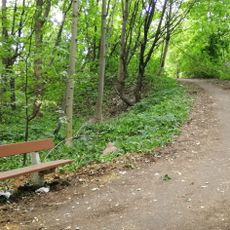
Camillus de Lellis Park in Tarnowskie Góry, Public park near St. Camillus church in Tarnowskie Góry, Poland.
Camillus de Lellis Park covers 6.6 hectares behind the former St. John's House, a neo-Gothic H-shaped building of 1906–1907. Its main lime-tree avenue linked the treatment centre to the farm buildings. Beds of beeches, hornbeams, white pines and spruces are interplanted with chestnuts, maples, ashes, robinias and birches, and footbridges cross the hollows left by a 19th-century dolomite quarry.
The hill was a public execution site from 1545, when a gallows was erected at the junction of roads from Bytom and Piekary. In 1906–1907 the Camillians built the neo-Gothic St. John's House on land donated by Count Lazarus Henckel von Donnersmarck, and in 1910 they laid out a 6.6-hectare park behind it.
The park's name honours the Camillians, who ran an alcohol-treatment institute here from 1904. A stone fountain at the entrance to the former quarry basin shows St John the Baptist pouring "living water" instead of the alcohol that afflicted the patients. A small monastic cemetery lies beside the cross marking the former gallows.
The park is accessible through multiple entrances and has parking areas near the main gates. Visitors should wear sturdy shoes since the terrain includes slopes and paths at different elevations.
The park's sunken paths follow the pits of a 19th-century dolomite quarry; in one exposed rock face a Marian grotto, called the Lourdes Grotto, was laid out in the 1920s. At the entrance to the hollow stands a stone fountain of St John the Baptist pouring "living water" instead of the alcohol treated here.
The community of curious travelers
AroundUs brings together thousands of curated places, local tips, and hidden gems, enriched daily by 94,706 contributors worldwide.