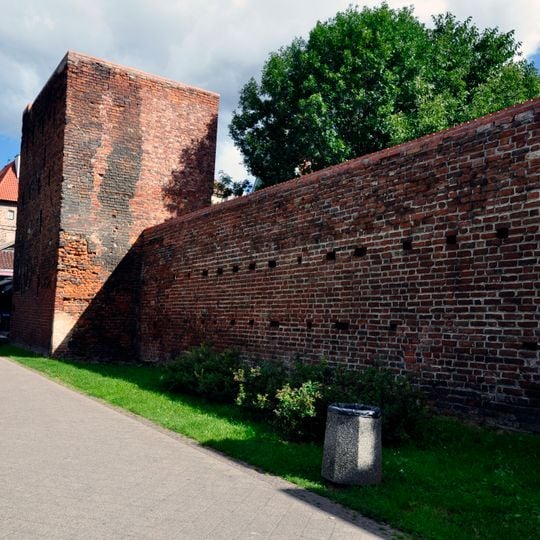
Fortifications of Gdańsk, Military fortifications in Gdańsk, Poland.
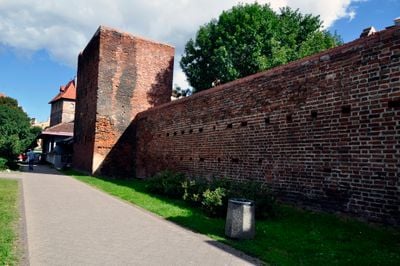
The Fortifications of Gdańsk (Twierdza Gdańsk) are a ring of bastions built from 1622 onward around the Right, Old, Fore and Lower Towns, the Granary Island, Bleihof and Langgarten. The Hagelsberg, from which Stefan Batory shelled the city in 1577, was fortified with bastions between 1655 and 1668. The complex includes the Reduit on the Hagelsberg (1811) and the Jesuit Redoubt on Englershöhe, rebuilt 1840–1867 with caponiers.
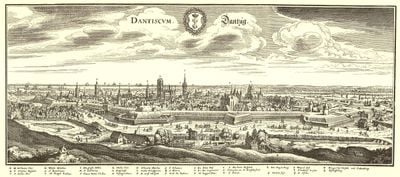
Gdańsk was turned into a fortress during the 17th century. In 1622, during the Polish-Swedish War, the Vistula became a base for the Polish fleet, and a ring of bastions was built around the Main Town, Old Town, Foretown and Lower Town, the granary island, Bleihof and Langgarten. The Hagelsberg, from which Stefan Batory had shelled the city in 1577, was fortified, and the bastions there were erected between 1655 and 1668. The works were extended in 1706–1710 during the Great Northern War, and in 1734 the city capitulated after a months-long siege by the Russian field marshal Münnich.
The fortress grounds on Hagelsberg now house the Hewelianum, an interdisciplinary education centre that took this name in October 2018; before that, from 2009, the site operated as the "Twierdza Gdańsk" culture park. Visitors can walk the bastions and casemates where this science and history centre is installed.
The fortifications are scattered across several hills and districts of Gdańsk, so plan routes between the Hagelsberg (Góra Gradowa), Biskupia Górka and the Vistula mouth separately. The Hewelianum science centre occupies the works on the Hagelsberg; check its opening days before climbing the hill. Remains of the 19th-century coastal batteries lie farther out toward Brzeźno and Nowy Port.
The Jesuit Redoubt on Jezuitska Hill (Englershöhe) was rebuilt between 1840 and 1867 as a fort with caponiers in the Neo-Prussian style. Its wall shelters are among the first structures in Prussia built of reinforced concrete, a material choice visitors can still trace in the surviving casemates.
The community of curious travelers
AroundUs brings together thousands of curated places, local tips, and hidden gems, enriched daily by 94,747 contributors worldwide.