Khirbet Tibnah, Archaeological tell in Ramallah and al-Bireh Governorate, West Bank.
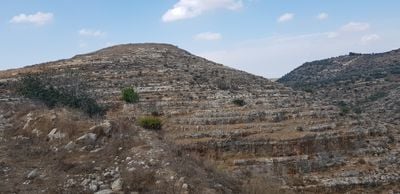
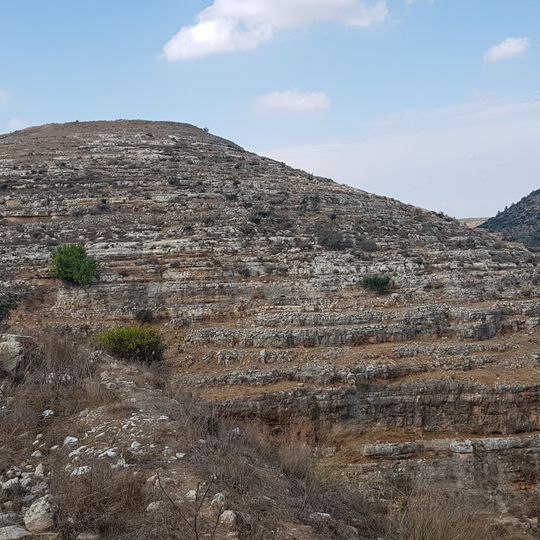
Khirbet Tibnah is an archaeological tell in the Ramallah and al-Bireh Governorate of the West Bank, between the villages of Deir Nidham and Nabi Salih. The mound rises from a valley and is shaped by stepped stone terraces of light grey and pale tan stones, with dry earth and sparse scrub between them. Its summit is flat and covered with pale stone and dry vegetation.
The site was first settled during the Early Bronze Age around 3300 BC and saw human activity continuing into the Roman, Byzantine, and Ottoman periods. Pottery deposits throughout the tells document this extended span of habitation.
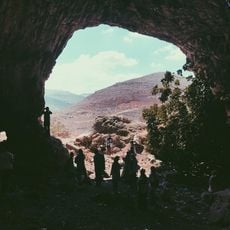
The necropolis on the north slope holds 16 known rock-cut tombs with kokhim burial shafts, some still containing ossuary remains; six more graves lie nearby. A large mikveh with two entrances sits in the valley just below. Archaeologist Dvir Raviv dates the cemetery from the Hellenistic period to the Bar Kokhba revolt.
The tell lies between the villages of Deir Nidham and Nabi Salih, about 1.5 km west of Neve Tzuf, with the spring of Ein Tibnah to the northwest and Wadi Reiya below the northern side. The terraced slopes are steep and the ground stony, so sturdy shoes help. The site is on privately claimed land and has no visitor facilities; arrange any visit in advance with the local Palestinian landowners or a guide.
The Roman road from Antipatris to Gophna ran through the valley south of the hill, not past a fortress on the summit. Eusebius' Onomasticon, written in the 4th century, records that Joshua's tomb was still shown to visitors near the village in his day.
The community of curious travelers
AroundUs brings together thousands of curated places, local tips, and hidden gems, enriched daily by 93,119 contributors worldwide.