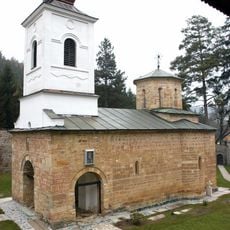
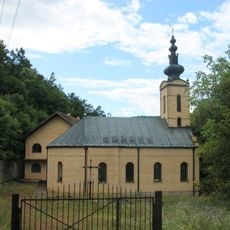
Divostin Monastery, Orthodox monastery in Divostin, Serbia.
Divostin Monastery is a Serbian Orthodox monastery in the village of Divostin, in the Sumadija region of central Serbia, built with stone walls and a church in the medieval style. The complex includes a walled courtyard, residential quarters for the monastic community, and a simply decorated chapel interior.
The identification of Divostin with the Διβισισχον mentioned in a charter of Emperor Basil II remains unresolved. The monastery is linked to the time of Despot Stefan Lazarević in the early 15th century. Its church was burned by the Ottomans around 1739, rebuilt in 1873 with help from the Drača monastery, demolished in 1969, and replaced by a new church consecrated in 1974.
The name Divostin derives from "dijevin stan", meaning "maiden's dwelling", as the monastery has been a women's community since its founding. A relief portrait of King Milan Obrenović (1854–1901) by sculptor Simeon Roksandić stands above the spring called Svetinja, which is dedicated to the Virgin Mary and still visited as a healing source. Between the world wars, the monastery hosted several religious assemblies described by Bishop Nikolaj Velimirović in his book "Divan".
The monastery is close to Kragujevac and is best reached by private vehicle along local roads. It is worth asking about visiting times in advance, as Serbian monasteries may close to outside visitors during certain religious feasts.
Archaeological remains of a Neolithic and a Roman settlement were found at Divostin, showing the site was inhabited long before the monastery. The monastery church also keeps a relief portrait of King Milan Obrenović (1854–1901) by sculptor Simeon Roksandić, set above the spring called Svetinja, which people still regard as healing.
The community of curious travelers
AroundUs brings together thousands of curated places, local tips, and hidden gems, enriched daily by 93,144 contributors worldwide.