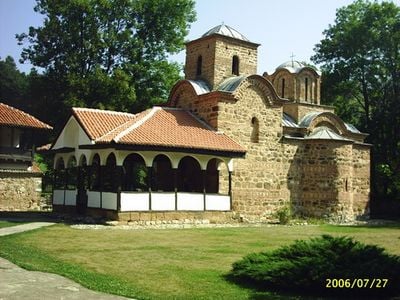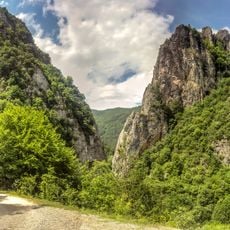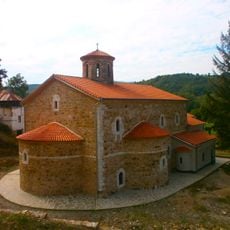
Poganovo Monastery, Serbian Orthodox monastery in Jerma River gorges, Serbia.
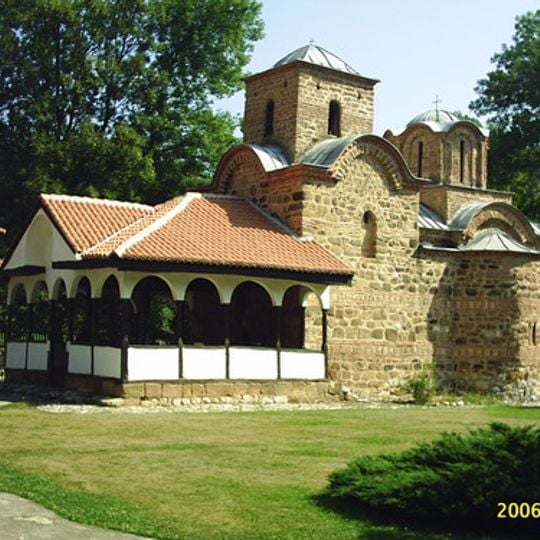
Poganovo Monastery stands on the left bank of the Jerma River near the village of Poganovo. Its church, in the Morava architectural style, has a single-nave naos with a dome, a developed-cross plan and an altar with two side apses. The walls are of dressed stone blocks over a foundation of rough stone bound with mortar; a low porch with white walls and a tile roof was added at the end of the 19th century.
Founded by the Serbian noble Konstantin Dejanović Dragaš, a nephew of Tsar Dušan, and completed after his death at the Battle of Rovine in 1395 by his daughter Jelena, a nun named Hypomene. The church was built at the end of the 14th century and painted in 1499 by artists from northern Greece. From 1870 to 1919 it was under the Bulgarian Exarchate, then passed to Serbia after World War I.
The monastery is dedicated to Saint John the Theologian, not Saint George; three round stones set into the west wall of the church bear the names John the Theologian, Lord Konstantin and Lady Jelena. It is a working men's monastery of the Niš Eparchy and hosts participants of the International Art Workshop "Poganovo Monastery". The village's old name, Dobroševo, was changed by the Ottomans to Poganovo and officially restored in January 1934.
The monastery sits in a mountainous area next to the Jerma gorge and is reachable on foot from the nearest village, though the path can be steep. Visitors should wear sturdy shoes and be prepared for natural surroundings and basic facilities on site.
Artists from northern Greece arrived in 1499 to paint the inner walls with biblical scenes and saint figures, with inscriptions written in Church Slavonic. These frescoes showcase the cultural exchange between Serbian and Greek artistic traditions from that period.
The community of curious travelers
AroundUs brings together thousands of curated places, local tips, and hidden gems, enriched daily by 93,662 contributors worldwide.