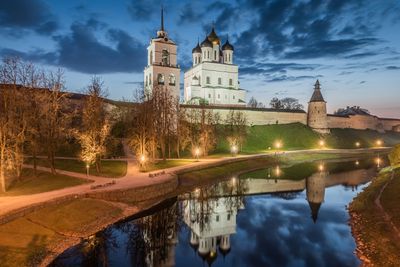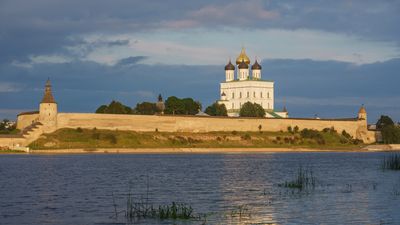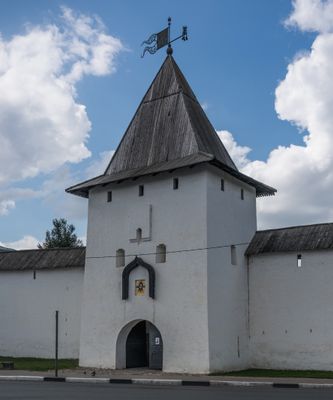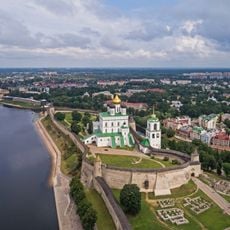
Pskov Krom, Fortified kremlin in Pskov, Russia.
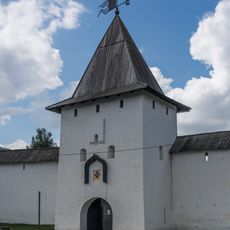
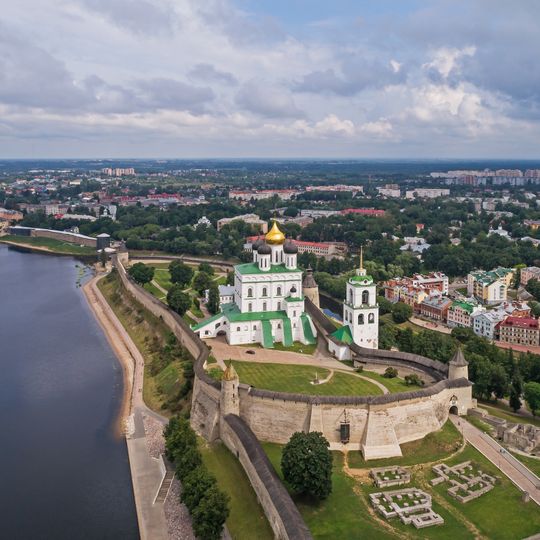
Pskov Krom is a fortified kremlin standing where two rivers meet, built with thick stone walls and multiple towers that define its outline. The complex holds churches, historic buildings, and open spaces arranged along the riverside.
The first chronicle mention of the "kromny town" dates to 1113, and wooden walls stood on the cape by the 8th century. Stone Persei wall was built in 1337 from local limestone, and by 1452 the whole perimeter was stone. In 1510 Pskov joined the centralized Russian state. In 2010 the Vlasyevskaya and Rybnitskaya towers were damaged by fire.
The Trinity Cathedral inside reflects how faith shaped medieval Pskov and remains a gathering space for both locals and visitors seeking spiritual connection. You can sense the bond between the fortress walls and the religious life that has centered here for centuries.
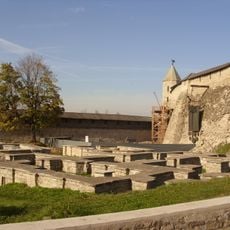
The Krom occupies a narrow, high promontory where the Pskova meets the Velikaya, so the ground drops away on both sides; the main entry is from the south, past the Persi wall and the bell tower. The site covers 3.5 hectares, with the adjoining Dovmontov gorod adding 1.5 hectares of excavated church foundations. The stone paving and the slope down to the river are uneven, so wear firm shoes.
The word "krom" may be the root of "kremlin": linguists link it to "kromstvo" (interior) or to "edge, border", and with a vowel shift and the suffix -l it could have produced "kreml". The first chronicle mention of the "kromny town" is dated 1113.
The community of curious travelers
AroundUs brings together thousands of curated places, local tips, and hidden gems, enriched daily by 94,092 contributors worldwide.