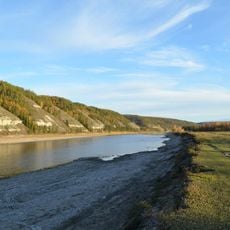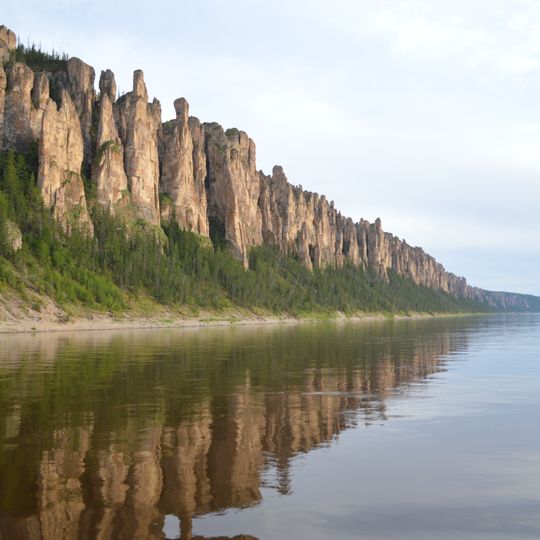
Lena Pillars, Natural monument near Lena River, Sakha Republic, Russia
Lena Pillars are upright rock formations along the Lena River in Khangalassky District of Sakha Republic, stretching for several kilometers and rising up to 220 m (722 ft) above the riverbank. The limestone walls display layers of different colors and contain caves and hollows carved by wind and water.
The limestone, marlstone, dolomite and slate layers date from the early to middle Cambrian, roughly 560–540 million years ago, laid down in sea basins of the Siberian Platform. The pillars themselves as a landform are far younger, about 400,000 years old: uplift opened fractures, and karst processes with erosion carved the columns. The park became a UNESCO World Heritage Site on 2 July 2012.
The Russian name Lenskiye Stolby and the Yakut Ölüöne Turūk Khayalara both describe the pillars. The surrounding land is traditionally used by Evenk communities, whose hunting and fishing rights the park administration recognises within defined boundaries. The Decembrist exile A. A. Bestuzhev-Marlinsky wrote of a "holy silence" over the untouched creation.
Most visitors reach the site between June and September, when river boats depart from Yakutsk and stop along the pillars. Trails lead to viewpoints on the cliffs, offering views over the formations and the river.
Fossils of marine organisms from the early Cambrian are embedded in the layers, documenting the development of life more than 500 million years ago. Some crevices show remains of trilobites and other early sea dwellers.
The community of curious travelers
AroundUs brings together thousands of curated places, local tips, and hidden gems, enriched daily by 93,177 contributors worldwide.