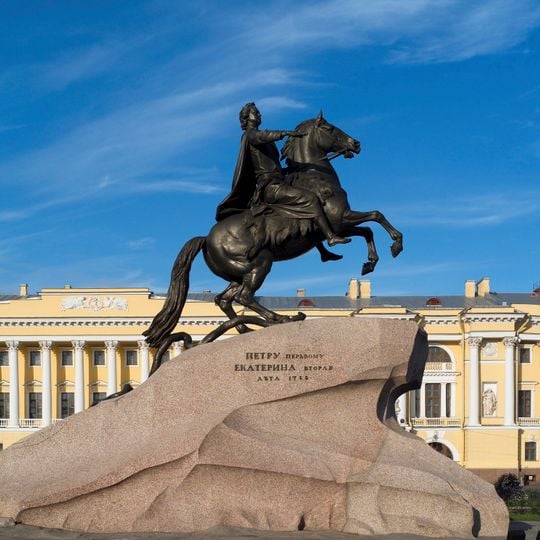
Bronze Horseman, Monumental bronze sculpture at Senate Square, Saint Petersburg, Russia
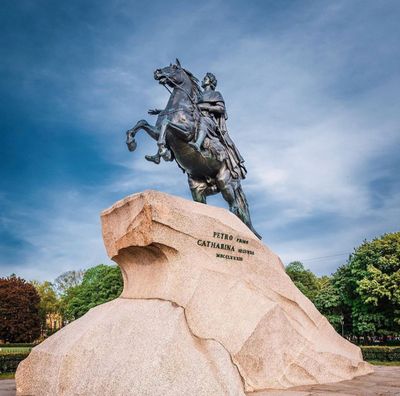
The Bronze Horseman is an equestrian monument on Senate Square in Saint Petersburg, showing the Russian tsar with his arm extended toward the Neva River. It rises about ten meters above a massive granite base, with the horse rearing on its hind legs and supported only by a crushed serpent beneath its tail.
French sculptor Étienne Falconet completed the monument between 1768 and 1778 under commission from Catherine the Great to honor Peter the Great. His assistant Marie-Anne Collot modeled the face of the tsar, while Falconet designed the overall composition and solved the delicate balance of the rearing horse.
The name "Bronze Horseman" comes from Pushkin's 1833 poem of the same name; the monument is actually cast in bronze, and the poet used the word "copper" for the rhythm of his verse. The Latin and Russian inscriptions on the stone read "Catherine the Second to Peter the First, 1782", a dedication by Catherine, who had no legal claim to the throne and presented herself as Peter's heir.
The monument is freely accessible throughout the year and offers good conditions for photography in the evening when lit. The square sits directly on the riverbank, so it can feel noticeably cooler and windier than the surrounding streets.
The pedestal is the Thunder Stone, a rapakivi granite boulder of about 1,250 tons, the largest stone ever moved by humans. A Greek engineer, Marinos Carburis, had it dragged over frozen ground on a metal sled sliding on bronze balls, with 400 men working nine months and no animals.
The community of curious travelers
AroundUs brings together thousands of curated places, local tips, and hidden gems, enriched daily by 94,071 contributors worldwide.