Bratzevo, Estate in Yuzhnoye Tushino District, Russia
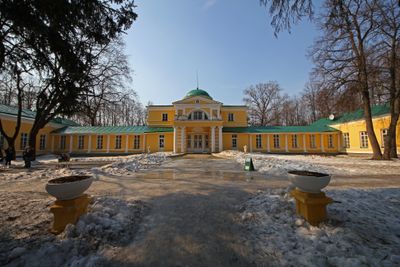
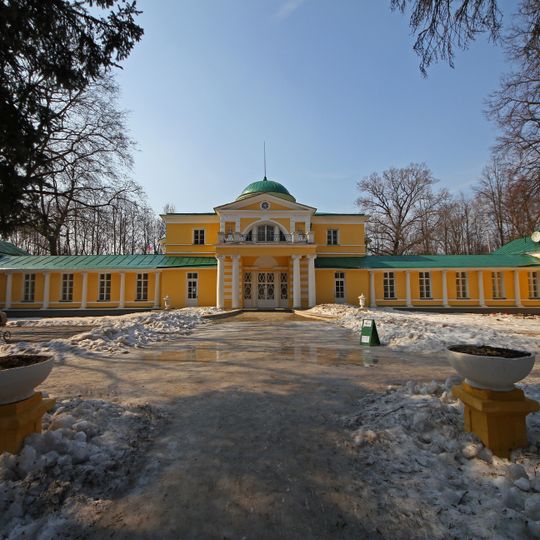
Bratzevo is a classical estate on the Skhodnya River in Moscow's Yuzhnoye Tushino District. Its two-storey main house, possibly designed by Andrey Voronikhin, has a round domed hall with a choir gallery. In 1936 architect Alexander Varshaver added one-storey wings in an H shape, glazed the side colonnades and painted the additions yellow with white trim.
The village of Bratsevo was recorded in the 16th century; in the 1650s boyar Bogdan Khitrovo acquired it and built the stone Church of the Intercession in the 1660s–1670s. In 1780 Count Alexander Stroganov bought the estate as a settlement for his wife Ekaterina Trubetskaya, who lived there with Ivan Rimsky-Korsakov; the stone main house dates from 1813–1815. After 1917 Prince Nikolai Shcherbatov handed the estate to the Soviet state, and in 1936 architect Alexander Varshaver rebuilt the house as a sanatorium wing.
The estate church, built under Bogdan Khitrovo in the 1660s–1670s, was rebuilt by Vasily Ladomirsky in 1833 and later repainted by Palekh masters under Prince Shcherbatov. Its chalice, paten and jewelled Gospel, made in Khitrovo's workshops, were taken in 1924 to the Kremlin Armoury. The park rotunda "Milovida" has ten columns.
The estate lies on the Skhodnya River in Moscow's Yuzhnoye Tushino District. The main house, rebuilt in 1936 with one-storey wings, now belongs to the Union of Theatre Workers and operates as a rest-home building; the park, ponds and rotunda are separate from it. The 2012 restoration altered the fountain's appearance, which local activists reported to Archnadzor.
During the 1930s, the estate served as a rehabilitation center for polar explorers led by Otto Schmidt. This unusual chapter transformed the classical property into a hub for Arctic research and recovery.
The community of curious travelers
AroundUs brings together thousands of curated places, local tips, and hidden gems, enriched daily by 94,319 contributors worldwide.