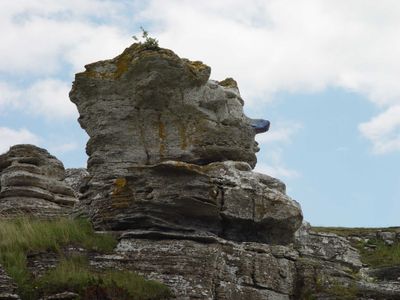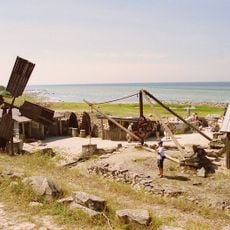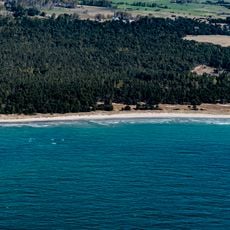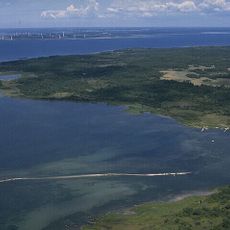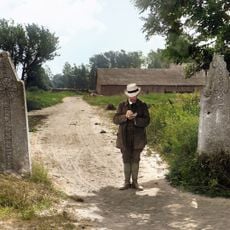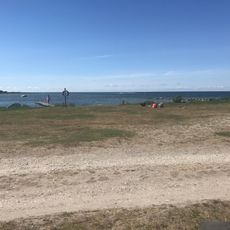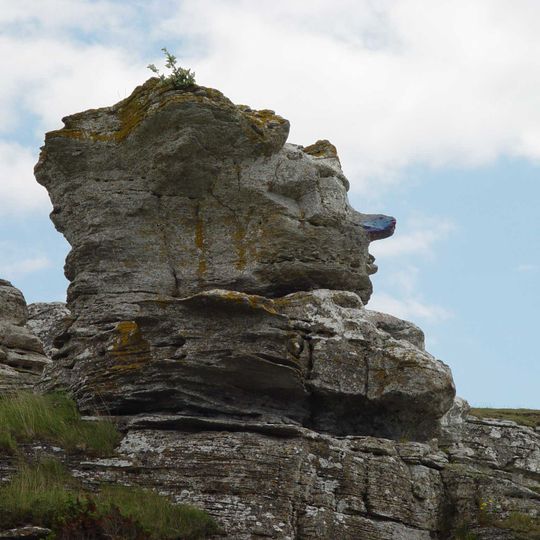
Hoburgen, Sea stack formation on Storsudret peninsula, Gotland Municipality, Sweden.
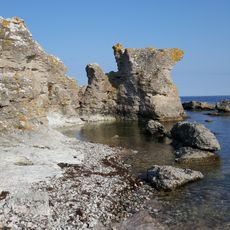
Hoburgen is a sea stack on the southern tip of the Swedish island of Gotland, where pale limestone cliffs fall straight down into the Baltic Sea. The formation stands as a freestanding block of rock, shaped by the sea cutting away the softer stone around it over a very long time.
The limestone that makes up the cliffs here was formed hundreds of millions of years ago as sediment on the floor of a shallow tropical sea. Over time, waves and wind wore away the softer rock, leaving behind the harder pillar that stands today.
Locals call the main rock formation "Hoburgsgubben," which translates roughly as "the old man of Hoburg." If you look at the cliff from the right angle, the eroded limestone appears to form the face of a bearded old man.
The site sits at the open southern edge of Gotland and is exposed to sea winds, so warm and windproof clothing is a good idea at any time of year. The path near the cliffs runs over uneven ground, so sturdy footwear is strongly recommended.
An asteroid carries the name "Hoburgsgubben," taken directly from the local name for this rock. This makes the limestone pillar at the tip of Gotland one of the rare geological formations on the island to have a named presence in astronomy.
The community of curious travelers
AroundUs brings together thousands of curated places, local tips, and hidden gems, enriched daily by 60,000 contributors worldwide.