Durdle Door, Natural limestone arch on the Jurassic Coast, England
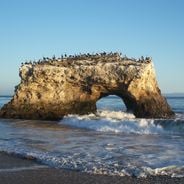
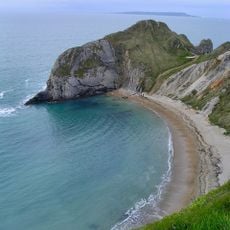
Durdle Door is a natural arch made of Portland limestone on the Jurassic Coast near West Lulworth. The formation stands about 200 feet above sea level, creating a door-shaped opening in the white cliffs that leans out over turquoise water.
The arch formed on a concordant coast where near-vertical bands of resistant Portland limestone run parallel to the shore, backed by a 120-metre band of weaker, easily eroded rock. Sea erosion removed nearly all the limestone, and erosion at the western end of the remaining band opened the arch. The steeply dipping strata belong to the Lulworth crumple, part of the Purbeck Monocline raised during the building of the Alps in the mid-Cenozoic.
Durdle is from Old English thirl, to pierce or bore; the arch was called the "Barn-door" in the late 19th century, when it was noted as high enough for a good-sized sailing boat to pass through. Dorset-born missionary Arthur Moule, a friend of Thomas Hardy, wrote verses about the tide at Durdle Door in his 1879 Songs of Heaven and Home. The arch has appeared in films including Wilde (1997) and the 1967 Far from the Madding Crowd.
Visitors reach the site through marked paths from West Lulworth village, where the descent to the beach can be steep and slippery. At high tide, access to the sandy beach below the arch becomes much more limited.
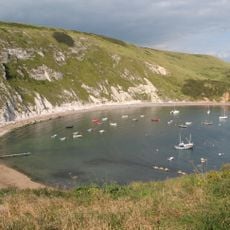
The strata at Durdle Door are almost vertical, not horizontal: the arch sits on the Lulworth crumple, part of the Purbeck Monocline raised by the building of the Alps in the mid-Cenozoic. The same Portland limestone band forms the narrow entrance to Lulworth Cove a mile away.
The community of curious travelers
AroundUs brings together thousands of curated places, local tips, and hidden gems, enriched daily by 92,568 contributors worldwide.